
Candidates who have declared their candidacy for the election of the Superintendent of Education in Jeonbuk are offering distinctly different solutions based on their own experiences and educational philosophies in the face of the common challenge of 'local extinction crisis'. With candidates including a university professor from a teaching background, a university president, an educational administrator, and former teachers, the differences in each candidate's educational philosophy are more clearly evident in this election than ever before.
Cheon Hosung: Education that Seeks Answers on the Ground
Candidate Cheon Hosung advocates for 'responsibility-centered education on the ground' as a core value. His main policy proposal, the 'Basic Academic Responsibility System', envisions tailored education from birth to university being the responsibility of the nation. He combines this with a comprehensive vision that includes future education using AI, a 4-dimensional education safety net created by students, parents, teachers, and the local community, and a model where schools and communities coexist to address the local extinction crisis.
Lee Namho: Decentralization of Authority and Restoration of Academic Competitiveness
Lee Namho defines Jeonbuk education as a 'comprehensive crisis' and, drawing on his experience as the former president of Jeonbuk University, emphasizes decentralizing authority as the core of reform. In his main policy proposal, the 'Local Responsibility Education Autonomy Innovation Plan', he boldly suggests transferring the authority of the provincial education office to the educational support office, introducing a system where residents participate in the selection of educational leaders, and focusing on raising the overall level rather than just resolving academic disparities.
Hwang Hojin and Yoo Seongdong: Change the Educational Administrative Structure Itself
Hwang Hojin and Yoo Seongdong officially formed a policy and innovation alliance on April 2, introducing a different voice. While Cheon Hosung and Lee Namho mainly focus on changes in educational content, Hwang Hojin and Yoo Seongdong are more passive about fundamental innovation in the educational administrative structure. They share the perception that the Superintendent of Education and the educational office organization should be decentralized and made more transparent. They also propose practical solutions combining field experience and administrative abilities. While Hwang Hojin shows an open stance on unification, Yoo Seongdong expresses his intention to see it through to the end, indicating a subtle difference between the two.
A Crossroads of Three Paths
Ultimately, the election for the Superintendent of Education in Jeonbuk is a confrontation of three paths. Cheon Hosung's 'ground-centered' path, Lee Namho's 'academic-centered and administrative decentralization' path, and Hwang Hojin and Yoo Seongdong's 'educational administrative structure innovation' path are competing based on their support base and vision.
A Common Shadow of Teacher-Centered Promises
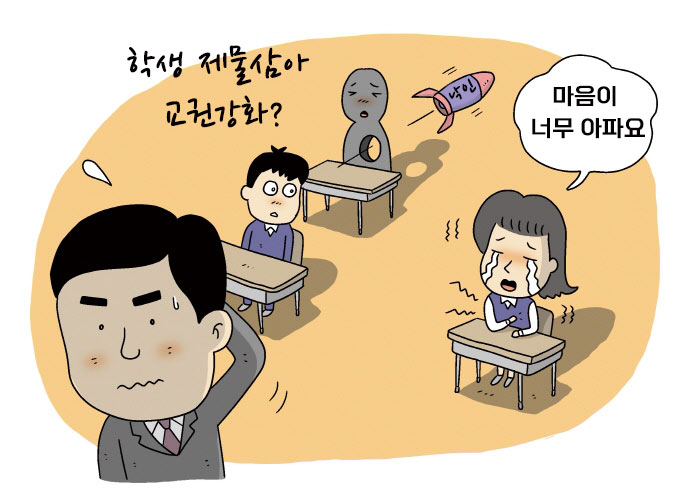
Despite the differences in paths, there is a common uncomfortable denominator for the candidates in this election. In all the candidates' promises, students do not emerge as the subjects of education. Whether it is basic academic skills, upward leveling, administrative decentralization, or structural innovation, all issues are ultimately designed in the language of teachers and educational administrators. Even though the protection of educational authority emerges as a top priority task, the fact that students, who are the reason for the existence of schools, are only mentioned as beneficiaries of promises without being portrayed as individuals with their own voices, is a point to be noted. The fact that the reality, where the protection of educational authority accounts for 68.1% of the top priority task among field teachers in the Jeonbuk Teachers' Union survey, is directly reflected in the design of the candidates' promises.
Teachers Can Also Become Perpetrators - Silent Candidates
While the discourse of protecting educational authority covers the election stage, there is an uncomfortable truth that candidates do not openly address. There are confirmed cases in the Jeonbuk region where some teachers have harassed students, accused and slandered parents, and systematically isolated them. The 'Red Card Incident' at M Elementary School in Jeonju is a typical example. A teacher, a former head of the local teachers' union, filed a criminal complaint against a parent and later controversially volunteered to be the homeroom teacher of the child of that parent. In other words, it was a struggle against parents and students.
This is not just an individual deviation but a structural problem. As the educational authority protection system strengthens, some teachers are paradoxically using it as a shield to justify the abuse of accusations and complaints against students and parents. There is almost no discussion about institutional checks on unfair complaints and accusations raised by teachers against students and parents. As candidates who are inevitably conscious of the organization of the teacher groups before the election, it is also difficult for them to address this issue head-on structurally.
The essence of education lies in treating each student as a complete individual. While educational authority and student rights are not opposing concepts, in the language of the Jeonbuk Superintendent of Education election, students tend to be depicted as subjects who must obey the authority of teachers rather than beings who should be protected. The courage to criticize teachers' unfair actions towards students, and the declaration to stand on the side of students even if it conflicts with the understanding of teacher organizations, are not yet evident in any candidate in this election.
Where is the 'Student-Centered Education'?
The criterion for distinguishing progress and conservatism in education is not political orientation but whether students are respected as the subjects of education or viewed only as objects to be managed and nurtured. In the past, during the era when the principle of 'true education' was elevated, with the Korean Teachers and Education Workers Union at the center, the progressive education sector received support because it placed student rights at the forefront of educational issues. However, finding the successor to that in the Jeonbuk Superintendent of Education election is not easy. While the candidates all cry out for innovation and reform, the vision of students as the designers of education, and schools as spaces where students themselves create, is not clearly articulated in any policy manifesto. For the proposition that education is for students to become the foundation of policy rather than just an election slogan, the voice of students must live within the core of promises, not just in the words of the candidates.
전북교육감 후보들, 교육정책에 학생은 주체가 아니라 교육의 대상화
전북교육감 선거에 출마를 선언한 예비후보들은 '지역소멸 위기'라는 공통 과제 앞에서 저마다의 경험과 교육 철학을 바탕으로 뚜렷이 다른 해법을 내놓고 있다. 현장교사 출신의 대학교수, 대학 총장, 교육행정가, 교사 출신들이 맞붙으면서 이번 선거에서는 각 후보의 교육 철학 차이가 어느 때보다도 분명하게 드러나고 있다.
천호성, 현장에서 답을 찾는 교육
천호성 후보는 '현장 중심 책임교육'을 핵심 가치로 내세운다. 대표 공약으로 '기초학력 완전책임제'는 출생부터 대학까지 맞춤형 교육을 국가가 책임지겠다는 구상이다. 여기에 AI를 활용한 미래교육, 학생·학부모·교사·지역사회가 함께 만드는 4차원 교육안전망, 학교와 지역이 상생하는 모델 등을 결합해 지역소멸 위기까지 함께 풀겠다는 복합적인 비전을 제시했다.
이남호, 권한 분산과 학력 경쟁력 회복
이남호 후보는 "전북교육은 총체적 위기"로 규정하며, 전북대학교 총장 출신으로 고등교육과 행정 경험을 자신만의 강점으로 내세우고 있다. 그는 교육감에게 집중된 권한을 분산시키는 것이 개혁의 핵심이라고 강조한다. 대표 공약인 '지역 책임교육 자치 혁신안'에서는 도교육청의 권한을 교육지원청에 과감하게 넘기고, 주민참여형 교육장 임명제를 도입해 교원, 학부모, 지역사회가 교육장 선발에 직접 참여하는 구조로 만들겠다고 밝혔다. 또한 학력 격차 해소보다는 전체 수준을 끌어올리는 '상향 평준화'를 강조하며, 수월성 교육에 무게를 두고 있다.
황호진·유성동: 교육행정 구조 자체를 바꿔라
황호진, 유성동 두 예비후보는 4월 2일 정책 및 혁신 연대를 공식화하며 색다른 목소리를 내기 시작했다. 두 후보 모두 천호성과 이남호가 주로 교육 내용의 변화에 초점을 두는 동안, 교육행정 구조의 근본적인 혁신에는 소극적이라고 날을 세우고 있다. 이들은 교육감과 교육청 조직 자체를 분권화하고 더욱 투명하게 만들어야 한다는 인식을 공유하며 연대를 구성했다. 또한 현장 경험과 행정 능력을 결합한 실용적인 방안을 내세우고 있다. 단일화 여부에 대해선 황호진이 열린 입장을 보이는 반면, 유성동은 끝까지 완주하겠다는 의사를 밝히는 등 두 사람 사이에 미묘한 차이가 감지된다.
세 가지 노선의 갈림길
결국 이번 전북교육감 선거는 세 가지 노선이 맞붙는 구도이다. 천호성의 '현장 중심' 노선, 이남호의 '학력중심·행정 분권' 노선, 그리고 황호진·유성동의 '교육행정 구조 혁신' 노선이 지지층과 비전을 놓고 경쟁하고 있다.
교사 중심 공약의 공통 그늘
그러나 노선의 차이에도 불구하고, 이번 선거 후보들에게는 한 가지 불편한 공통분모가 있다. 어느 후보의 공약에서도 학생은 교육의 주체로 등장하지 않는다는 점이다. 기초학력, 상향 평준화, 행정 분권, 구조 혁신 등, 모든 의제가 결국 교사와 교육행정가의 언어로 설계된 교육이다. 교권 보호가 최우선 과제로 부상한 현실을 외면할 수 없다 해도, 학교의 존재 이유인 학생이 공약의 수혜 대상으로만 호명될 뿐 스스로 목소리를 갖는 주체로 그려지지 않는다는 사실은 눈여겨봐야 할 지점이다. 전북교총 설문에서 현장 교원들의 최우선 과제로 교권보호가 68.1%를 차지한 현실이 후보들의 공약 설계에 그대로 투영됐다는 점도 그 반증이다.
교사도 가해자가 될 수 있다 - 침묵하는 후보들
교권 보호 담론이 선거판을 뒤덮고 있는 동안, 후보들이 공개적으로 꺼내지 않는 불편한 진실이 있다. 일부 교사들이 학생을 괴롭히고, 학부모를 무고·모함하며 조직적으로 고립시키는 사례가 전북 지역에서도 현실로 확인되고 있다는 점이다. 전주 M초와 '레드카드 사건'은 그 전형적인 사례로 꼽힌다. 학부모를 형사 고발한 전교조 지부장 출신 교사가 이후 해당 학부모의 자녀가 속한 학급 담임을 자청해 논란이 커졌다. 한마디로 학부모와 학생을 상대로 힘틀막을 시전한 것이다.
이는 단순히 개인의 일탈이 아니라 구조적 문제다. 교권 보호 제도가 강화될수록, 일부 교사들은 이를 방패 삼아 학생과 학부모를 상대로 한 무고·고발 남용을 정당화하는 수단으로 활용하는 역설이 발생하고 있다. 교사가 먼저 학생과 학부모를 상대로 제기하는 부당한 민원과 고발에 대한 제도적 견제는 거의 논의되지 않고 있다. 선거를 앞두고 교원단체의 조직표를 의식할 수밖에 없는 후보들로서는 이 문제를 정면으로 다루기가 구조적으로 어렵다는 점도 부인하기 힘들다.
교육의 본질은 학생 한 명 한 명을 온전한 인격으로 대우하는 데 있다. 교권과 학생인권은 대립하는 개념이 아니지만, 지금 전북교육감 선거의 언어에서 학생은 보호받아야 할 존재이기 이전에 교사의 권위에 복종해야 할 대상으로 그려지는 경향이 짙다. 학생을 향한 교사의 부당한 행위를 비판할 용기, 그리고 교원 조직의 이해와 충돌하더라도 학생 편에 서겠다는 선언, 이번 선거에서 그런 후보는 아직 나타나지 않고 있다.
'학생이 주체인 교육'은 어디에 있는가
교육의 진보와 보수를 가르는 기준은 정치적 성향이 아니라, 학생을 교육의 주체로 존중하느냐, 아니면 관리하고 길러내야 할 대상으로만 바라보느냐에 있다. 과거 전교조를 중심으로 '참교육'의 기치를 높이던 시절, 진보 교육 진영이 지지를 받았던 이유는 학생인권을 교육 의제의 전면에 세웠기 때문이다. 그러나 이번 전북교육감 선거에서 그 계승자를 찾기는 쉽지 않다. 후보들은 저마다 혁신과 개혁을 외치지만, 학생을 교육의 설계자로, 학교를 학생이 스스로 만들어가는 공간으로 그리는 비전은 어느 공약집에도 선명하게 담기지 않았다. 교육은 학생을 위한 것이라는 명제가 선거 구호가 아닌 정책의 토대가 되기 위해서는, 학생의 목소리가 후보의 입이 아닌 공약의 뼈대 속에 살아 있어야 한다.