
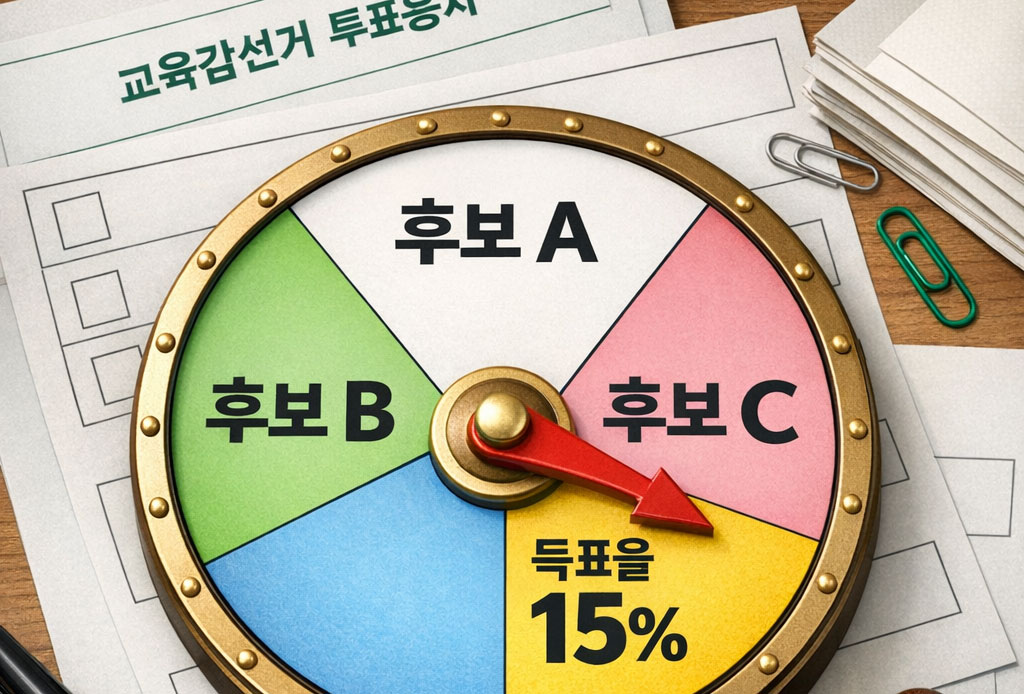
Since 2014, the candidate numbers have disappeared from the ballot papers for the superintendent of education elections. Following criticism that fixed numbers distort voters' judgment, the 'rotation system' was introduced. This system changes the order of candidate names in each electoral district to prevent a specific candidate from monopolizing the top spot.
Certainly, the system has become fairer than before. However, another question arises. In elections without numbers, what criteria do voters use to choose a superintendent of education? Looking at the data from the recent three local elections, a clear trend is evident. In superintendent of education elections where three candidates ran after the introduction of the rotation system, the third-place candidate has never fallen below a vote share of 15%.
Examining the results of superintendent of education elections from the 6th local election in 2014 to the 8th in 2022, where only three candidates ran, there were a total of 12 cases. Among these, there was never a case where the third-place candidate received less than 15% of the votes. This means that in all regions, the third-place candidate surpassed the threshold of 15%, which is the standard for full reimbursement of election expenses.
In the 7th local election in 2018, three-way races were held in seven cities including Seoul, Incheon, Gwangju, Daegu, Chungcheongnam-do, Jeollanam-do, and Sejong. In Seoul, Cho Hui-yeon received 46.59%, Park Sun-young 36.15%, and Cho Young-dal 17.26% of the votes. In Incheon, Do Sung-hoon received 43.77%, Ko Seung-ui 29.79%, and Choi Sun-ja 26.43%. Gwangju had Jang Hwi-guk with 37.97%, Lee Jung-sun 35.80%, and Choi Young-tae 26.23%, while in Daegu, Kang Eun-hee received 40.73%, Kim Sa-yeol 38.09%, and Hong Deok-ryul 21.16%. Chungcheongnam-do had Kim Ji-cheol with 44.07%, Myeong No-hui 29.76%, and Jo Sam-rae 26.15%, and Jeollanam-do had Jang Seok-woong with 38.36%, Ko Seok-gyu 34.22%, and Oh In-seong 27.41%. In Sejong, Choi Gyo-jin received 50.07%, Choi Tae-ho 31.65%, and Song Myung-seok 18.26%.
A similar trend continued in the 8th local election in 2022. In Jeollabuk-do, Seo Geoseok received 43.52%, Cheon Ho-seong 40.08%, and Kim Yun-tae 16.38%. Jeollanam-do had Kim Dae-jung with 45.08%, Jang Seok-woong 37.05%, and Kim Dong-hwan 17.86%, while in Incheon, Do Sung-hoon received 41.46%, Choi Gye-woon 39.49%, and Seo Jeong-ho 19.03%. In Gyeongsangbuk-do, Im Jong-sik received 49.77%, Ma Suk-ja 27.73%, and Im Jun-hee 22.49%, and Chungcheongnam-do had Kim Ji-cheol with 33.79%, Lee Byeong-hak 27.29%, and Jo Young-jong 22.48%.
Ultimately, since the implementation of the rotation system, all third-place candidates in superintendent of education elections with three competitors have exceeded 15% of the vote share. This is not an occasional occurrence but a consistent pattern in election structures.
Why do these results occur?
First, it is due to the physical dispersion of votes. In elections with only three choices, there is limited room for votes to be divided. Unlike scenarios with five or more candidates, where votes can be spread out, weaker candidates in three-way races can establish a certain voting base more easily.
Second, after the disappearance of numbers, the proxy voting nature has become more pronounced. Although superintendent of education elections do not overtly reveal party affiliations, there has always been an underlying battle between progressive and conservative ideologies, as well as support or opposition to current educational administration. In the absence of numbers, voters naturally tend to vote based on names, backgrounds, and the signals they perceive from the candidates. In such three-way races, each faction secures a certain portion of their votes firmly, preventing the third-place vote share from easily deteriorating.
Third, the unique atmosphere of 'conscience voting' in superintendent of education elections also plays a role. Unlike elections for members of the National Assembly or metropolitan mayors, in superintendent of education elections, there are surprisingly many voters who cast their votes based on policies, educational philosophies, experience, and symbolism. If a specific candidate distinctly represents keywords such as innovative education, basic academic skills, special education, student rights, or the restoration of educational authority, they are likely to have a stable support base regardless of their chances of winning.
Fourth, the structural disadvantages faced by the third-place candidate have been reduced with the introduction of the rotation system. Previously, the fixed numbers drew excessive attention to the candidates at the top, leaving those at the back at a disadvantage. However, after the rotation system, candidates are evenly distributed at the front, middle, and back of the ballot papers. With the decrease in the 'number effect' based on the order, the third-place candidate can now maintain a stable voting base more effectively than before.
Actual figures support this trend. The average third-place vote share in the 12 cases is approximately 21.6%, with a median of about 21.8%. The lowest was the 16.38% recorded by Kim Yun-tae in Jeollabuk-do in 2022, while the highest was the 27.41% achieved by Oh In-seong in Jeollanam-do in 2018.
However, even in three-way races, the results varied slightly depending on the dynamics. When candidates with similar ideological tendencies overlapped, the average third-place vote share was generally lower. In cases where support bases of candidates overlapped, such as in Jeollabuk-do, Jeollanam-do, and Gyeongsangbuk-do in 2022, the average third-place vote share dropped to about 18.9%. On the other hand, when clear ideological factions faced off, the average third-place vote share rose to about 23.2%. Ultimately, the most critical variable determining the lower limit of the third-place vote share was not the number of candidates but how much the ideological factions overlapped.
At this point, the 2026 Jeollabuk-do superintendent of education election comes into focus again.
If this election maintains a three-way race until the end, based on historical data, there is a high likelihood that the third-place candidate will exceed 15%. At least, the cases after the introduction of the rotation system indicate so. The full reimbursement threshold for election expenses is not just a simple expectation but a factual boundary repeatedly confirmed by actual data.
However, Jeollabuk-do is also an area that needs to be closely monitored. Since the introduction of the rotation system, the lowest third-place vote share in a three-way race nationwide was the 16.38% recorded in Jeollabuk-do in 2022. While the trend suggests a possibility of surpassing 15%, if a similar factional split occurs again, the third-place vote share in Jeollabuk-do could drop to that critical threshold.
Although the numbers have disappeared, the structure of voter sentiment remains. Even without numbers, voters have divided their choices based on the factions, personalities, and educational issues they believe in. Therefore, in a three-way race, the third-place candidate has always secured a certain share. While the rotation system may have eliminated the number effect, it has not changed the terrain of votes created by the three-way dynamics.
If the 2026 Jeollabuk-do superintendent of education election becomes a three-way race, there is one question.
The question is not whether the third-place candidate will exceed 15%, but whether Jeollabuk-do will record another near-bottom third-place vote share nationally, as in 2022, or create a stable third-place at the average level of other regions.
3명 출마 모든 교육감 선거에서 3위 후보까지 15% 이상 득표하게되는 이유는?
교호순번제 시대 교육감 3파전 전수 분석… 12곳 모두 3위 후보 선거비용 보전선 넘겨
2014년부터 교육감 선거 투표용지에서 후보 기호가 사라졌다. 고정된 번호가 유권자의 판단을 왜곡한다는 비판이 이어진 끝에 ‘교호순번제’가 도입됐다. 이 제도는 선거구마다 후보 이름의 배열 순서를 바꿔가며, 특정 후보가 앞자리를 독식하지 못하도록 한 것이다.
분명 제도는 이전보다 더 공정해졌다. 하지만 동시에 또 다른 질문이 남는다. 기호가 없는 선거에서 유권자들은 과연 무엇을 기준으로 교육감을 선택하는 걸까? 그리고 최근 세 번의 지방선거 데이터를 살펴보면 한 가지 뚜렷한 경향이 보인다. 교호순번제가 도입된 이후 3명이 출마한 교육감 선거에서는 3위 후보가 단 한 번도 득표율 15% 아래로 떨어진 적이 없다는 점이다.
중앙선거관리위원회 역대 교육감 선거 개표 결과를 살펴보면, 교호순번제가 적용된 2014년 제6회 지방선거부터 2022년 제8회까지, 3명만 출마한 교육감 선거는 총 12건이었다. 이 중 3위 후보의 득표율이 15%를 밑돈 경우는 한 번도 없었다. 모든 지역에서 3위 후보가 선거비용 전액 보전 기준인 15%를 넘겼다는 이야기다.
2018년 제7회 지방선거에서는 서울, 인천, 광주, 대구, 충남, 전남, 세종 등 7개 시도에서 3파전이 펼쳐졌다. 서울에서는 조희연이 46.59%, 박선영이 36.15%, 조영달이 17.26%의 득표율을 기록했다. 인천에서는 도성훈 43.77%, 고승의 29.79%, 최순자 26.43%였다. 광주는 장휘국 37.97%, 이정선 35.80%, 최영태 26.23% 순이었고, 대구에서는 강은희 40.73%, 김사열 38.09%, 홍덕률 21.16%였다. 충남은 김지철 44.07%, 명노희 29.76%, 조삼래 26.15%, 전남은 장석웅 38.36%, 고석규 34.22%, 오인성 27.41%였다. 세종은 최교진 50.07%, 최태호 31.65%, 송명석 18.26%로 집계됐다.
2022년 제8회 지방선거에서도 비슷한 양상이 이어졌다. 전북에서는 서거석이 43.52%, 천호성이 40.08%, 김윤태가 16.38%를 얻었다. 전남은 김대중 45.08%, 장석웅 37.05%, 김동환 17.86%였고, 인천에서는 도성훈 41.46%, 최계운 39.49%, 서정호 19.03%였다. 경북에서는 임종식이 49.77%, 마숙자 27.73%, 임준희가 22.49%, 충남은 김지철 33.79%, 이병학 27.29%, 조영종 22.48%였다.
결국 교호순번제 시행 이후 3명이 경쟁한 교육감 선거에서 3위 후보 모두 득표율 15%를 넘겼다. 한두 번의 예외가 아닌, 꾸준히 반복되는 선거 구조라 볼 수 있다.
왜 이런 결과가 나타날까.
첫째, 표가 물리적으로 분산되는 구조 때문이다. 선택지가 딱 세 명뿐인 선거에서는 표가 나뉠 여지 자체가 작다. 네다섯 명이 출마하는 구도와는 달리, 표가 여러 갈래로 퍼지지 않으니 상대적으로 약한 후보라도 일정한 득표 기반을 잡기 쉽다.
둘째, 기호가 사라진 이후 오히려 진영 대리투표 성격이 더욱 또렷해졌기 때문이다. 교육감 선거는 겉으로는 정당을 드러내지 못하게 돼 있지만, 실제로는 늘 진보와 보수, 그리고 현행 교육 행정에 대한 찬반 대결이 작동해 왔다. 기호라는 단서가 사라진 자리, 유권자들은 더 자연스럽게 이름, 경력, 그리고 자신이 읽어내는 진영 신호를 따라 표를 행사하게 된다. 이런 3파전에서는 각 진영이 어느 정도 자기 표를 단단히 확보하게 돼 3위 득표율이 쉽게 망가지지 않는다.
셋째, 교육감 선거 특유의 ‘소신투표’ 분위기도 한몫한다. 국회의원이나 광역단체장 선거에 비해, 교육감 선거에서는 정책이나 교육 철학, 경력, 상징성을 보고 표를 던지는 유권자가 의외로 많다. 특정 후보가 혁신교육이나 기초학력, 특수교육, 학생인권, 교권 회복 같은 키워드를 뚜렷하게 대표하고 있다면, 당선 가능성과는 별개로 흔들리지 않는 지지층을 갖게 마련이다.
넷째, 교호순번제 도입으로 3위 후보가 받는 구조적 불이익도 덜어졌다. 이전엔 고정된 기호가 앞번호 후보에게 지나친 주목을 쏠리게 하고, 뒤쪽 후보는 늘 불리하다는 지적이 많았다. 하지만 교호순번제 이후로는 투표용지 앞, 중간, 뒤에 후보들이 고루 배치된다. 순서에 따른 ‘번호 효과’가 줄면서, 3위 후보도 이전보다 안정적으로 득표 기반을 지킬 수 있게 된 셈이다.
실제 수치도 이런 흐름을 뒷받침한다. 12개 사례의 3위 득표율 평균은 약 21.6%, 중앙값은 약 21.8%다. 최저치는 2022년 전북에서 김윤태 후보가 기록한 16.38%였고, 최고치는 2018년 전남 오인성 후보의 27.41%였다.
그렇지만, 똑같이 3파전이어도 구도에 따라 결과는 조금 달랐다. 같은 진영 성향의 후보들이 겹쳐 나온 경우에는 3위 득표율이 전반적으로 낮았다. 2022년 전북, 전남, 경북처럼 후보 간 지지층이 겹칠 때는 3위 평균이 약 18.9%까지 내려갔다. 반면, 서로 색깔이 뚜렷한 진영끼리 맞붙었을 때는 3위 평균이 약 23.2%로 올라갔다. 결국 3위 득표율의 하한선을 결정하는 가장 핵심 변수는 후보 수 자체보다는, 진영 구도가 얼마나 중첩되는지였다.
이 지점에서 2026년 전북교육감 선거가 다시 눈에 들어온다.
만약 이번 선거가 끝까지 3파전 구도를 유지한다면, 역대 데이터만 놓고 볼 때 3위 후보가 15%를 넘길 가능성이 꽤 높다. 적어도 교호순번제가 도입된 이후의 사례들이 그렇게 말해준다. 선거비용 전액 보전선은 단순한 기대치가 아니라, 실제 데이터가 반복적으로 찍어낸 경계선이라는 사실도 확인된다.
그러나 전북은 동시에 가장 주의 깊게 봐야 할 지역이기도 하다. 교호순번제 이래 3파전 전국 최저 3위 득표율이 바로 2022년 전북에서 기록된 16.38%였기 때문이다. 흐름상 15% 돌파 가능성은 충분하지만, 만약 다시 같은 진영 분열이 벌어진다면 3위 후보 득표율이 그 경계선까지 떨어질 수도 있다는 점을 전북 사례가 보여준다.
기호는 사라졌지만, 표심의 구조는 자취를 남겼다. 유권자들은 기호 없이도 자신이 믿는 진영, 인물, 교육 의제를 기준으로 선택을 나눴고, 그래서 3파전 구도에서는 3위 후보 역시 일정한 몫을 항상 가져갔다. 교호순번제가 번호 효과를 지웠을지언정, 3자 구도가 만들어내는 득표의 지형까지는 바꾸지 못했다.
2026년 전북교육감 선거가 3파전으로 완주된다면, 질문은 하나다.
3위가 15%를 넘기는지가 아니라, 전북이 다시 한 번 전국 최저 득표에 가까운 살얼음판 3위를 기록할지, 아니면 다른 지역 평균 수준의 안정된 3위를 만들어낼지, 바로 그 점이다.