
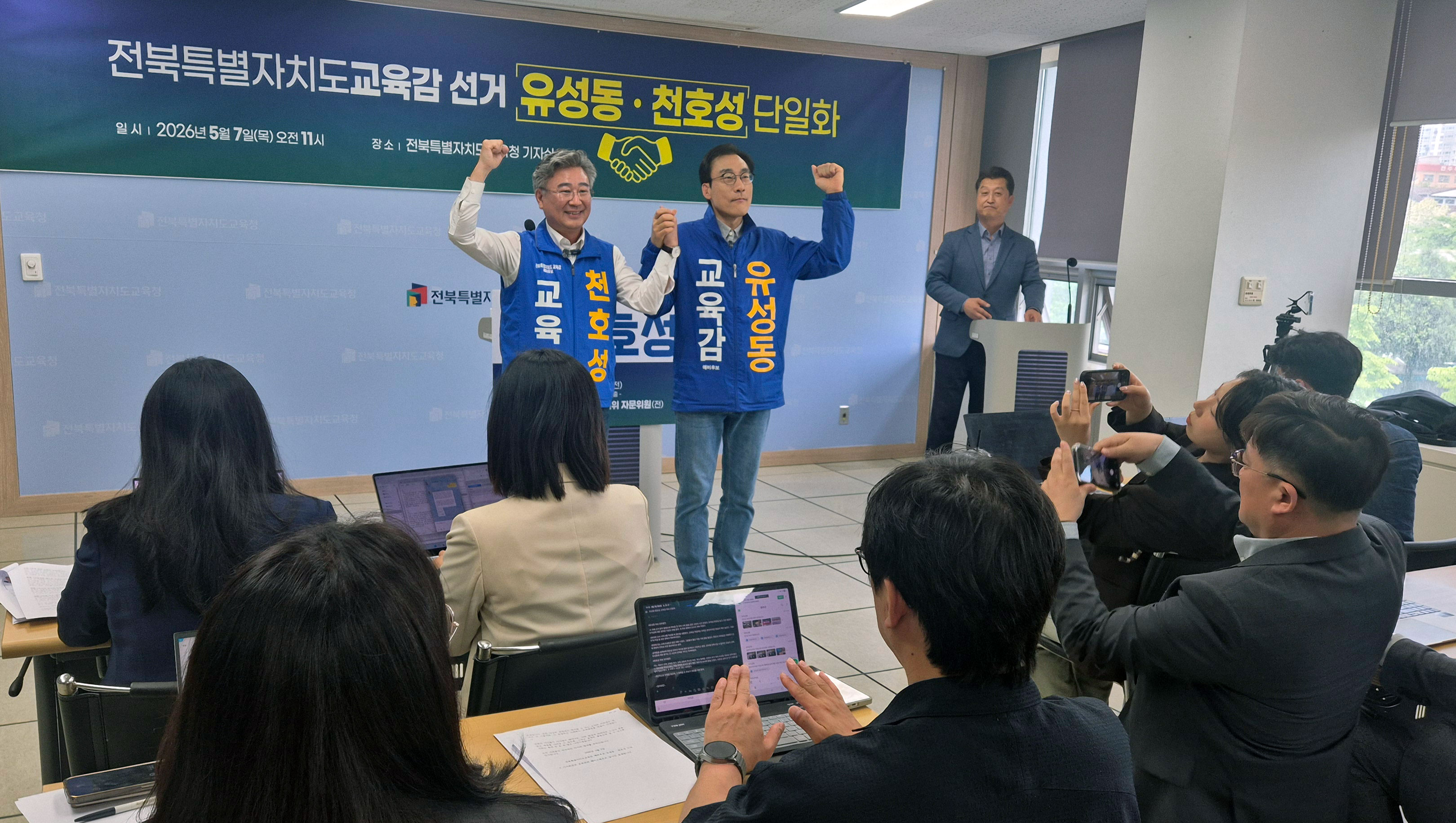
Cheon Hosung and Yoo Seongdong, the prospective candidates for the North Jeolla Province Superintendent of Education, held a joint press conference at the North Jeolla Provincial Office of Education at 11 a.m. on the 7th and declared the unification of Cheon Hosung as the sole candidate. As a result, the North Jeolla Province Superintendent of Education election for the June 3 local elections has been finalized as a final showdown between Cheon Hosung and Lee Namho.
Yoo Seongdong stated, "We have come together for the future of education in North Jeolla," explaining the background of the unification, while Cheon Hosung responded, "I deeply appreciate Yoo Seongdong's decision. I will do my best for the innovation of education in North Jeolla."
From a 4-way race to a final showdown: The long journey of unification
This unification is the result of a six-month process of a 4-way race and complex negotiations. The North Jeolla Superintendent of Education election, which was held without the incumbent premium due to the confirmation of the nullification of the election due to violation of the Public Official Election Act by Seo Geoseok, started as a 4-way race between Cheon Hosung, Lee Namho, Hwang Hojin, and Yoo Seongdong in an 'absolute power vacuum' scenario.
In January and February 2026, the North Jeolla Education Reform Commission led the discussions on unification with a focus on Cheon Hosung and No Byeongseop as the Democratic Progressive single candidates. Yoo Seongdong, Lee Namho, and Hwang Hojin either abstained or took a reserved position. However, in February, allegations of plagiarism and ghostwriting against Cheon Hosung weakened the momentum for unification by the Education Reform Commission. Yoo Seongdong even publicly criticized, stating, "Cheon Hosung cannot escape the label of a habitual plagiarist," which led to a cold relationship between the two candidates.
On April 2, Yoo Seongdong and Hwang Hojin declared a 'policy innovation alliance,' seemingly forming a new unification axis of progressive and moderate forces. The two candidates formalized their cooperation under the common principles of 'educational innovation and practicality.'
However, on April 14, Lee Namho and Hwang Hojin declared the unification towards Lee Namho, completely reversing the situation. Hwang Hojin, after just 12 days, broke the alliance with Yoo Seongdong and switched to Lee Namho's side. Yoo Seongdong expressed strong feelings of betrayal, stating, "I received a unilateral notice with a phone call at 11 p.m. last night." Furthermore, immediately after the unification declaration, a false text message claiming that Lee Namho, Hwang Hojin, and Yoo Seongdong had agreed to unify together spread widely. Yoo Seongdong held an emergency press conference to disclose the message and demanded an investigation by the Election Commission and judicial authorities, calling it a clear dissemination of false information.
On April 28, all members of Hwang Hojin's election campaign staff, public relations, and policy line declared a collective departure, stating it was a 'unilateral decision without discussion,' and switched their support to Yoo Seongdong. Cracks within the Lee Namho-Hwang Hojin unification became apparent.
On May 4, Kim Seunghwan, the former North Jeolla Superintendent of Education, publicly announced his support for Cheon Hosung. Lee Hanggeun, the former Jeonju Education Superintendent who competed against Cheon Hosung in the previous North Jeolla Superintendent of Education election, also joined in. Kim Seunghwan's endorsement, who served three terms and laid the foundation for innovative education in North Jeolla, decisively accelerated the consolidation of the progressive camp.
Then, on May 7 at 11 a.m., Cheon Hosung and Yoo Seongdong officially declared their unification through a press conference, confirming the final showdown between Cheon Hosung and Lee Namho for the North Jeolla Superintendent of Education election.
Support for Lee Namho by Seo Geoseok
The decisive factor that shook the unification negotiations was the presence of Seo Geoseok, the former Superintendent of Education. Lee Namho, the prospective candidate, has a deep connection with Seo Geoseok through Jeonbuk University. When Seo Geoseok served as the 15th and 16th president of Jeonbuk University, Lee Namho served as the head of the industry-academic cooperation department, and later, when Lee Namho took office as the 17th president, he practically continued the lineage. The fact that Seo Geoseok's close aides had already officially supported Lee Namho was also in line with this trend.
Lee Namho named his educational vision 'Academic Advancement 3.0,' stating, "Kim Seunghwan's era was 1.0, Seo Geoseok's administration was 2.0, and my vision is 3.0." He openly declared his intention to inherit and develop policies from Seo Geoseok's era. Some in the education sector have criticized that Lee Namho's major pledges are practically the same as the policies and direction during Seo Geoseok's era.
After the unification declaration between Lee Namho and Hwang Hojin, there were discussions within the education sector that Seo Geoseok was the actual designer of this unification. The 'Seo Geoseok Again' frame quickly spread, and a strong alarm bell rang within the progressive and reformist education circles.
Increasing sense of crisis within the progressive camp redraws the battle lines
The 'Seo Geoseok Again' frame began to change the atmosphere within the progressive camp. The influence of Seo Geoseok, who fell due to a violation of the Public Official Election Act, could return to the education scene through Lee Namho, leading to a rapid spread of the sense of crisis. In fact, until then, support for Cheon Hosung within the progressive camp was not high. The allegations of mutual plagiarism and ghostwriting between Cheon Hosung and Lee Namho in February remained unresolved, and the relationship between the two candidates was cold, with Yoo Seongdong openly criticizing Cheon Hosung.
However, with the unification of Lee Namho and Hwang Hojin, the battle lines in the election structure were redrawn. A consensus emerged that it was necessary to prevent the revival of the 'Seo Geoseok regime' rather than individual dissatisfaction with the candidates. The need for consolidation around Cheon Hosung among progressive and reform-oriented voters began to gain momentum.
Yoo Seongdong's decision completes a paradoxical effect
Amidst all these developments, Yoo Seongdong made a decision on unification. Despite being from Jeonbuk, Yoo Seongdong had faced difficulties in forming a support base within the region due to having worked in teaching in other areas for a long time. His neutral stance on educational policies and routes, not leaning towards any faction, made it difficult to consolidate his support base. This raised doubts throughout the election whether his independent completion would lead to tangible results.
Before the decision on unification, Yoo Seongdong said last week, "After participating in several televised debates, I have had many thoughts on what choice would be best for North Jeolla education and students." This statement indicates that the decision on unification stemmed from a pure judgment for North Jeolla education and students, rather than based on factional logic or political gains. As Yoo Seongdong has maintained a moderate stance, his decision is being perceived as a decision transcending factions.
Ultimately, while Seo Geoseok, the former Superintendent of Education, sought to become an asset for Lee Namho's camp, paradoxically, it led to catalyzing the consolidation of the progressive camp, and Yoo Seongdong's decision to unify with Cheon Hosung is seen as a crucial background in the education sector and beyond.
Choice of the moderate and undecided
With the confirmation of the final showdown between the two candidates, the biggest variable in the remaining election period will be the sentiment of the moderate and undecided voters. It is anticipated that the key to the final showdown on June 3 will be whether the support base brought by Yoo Seongdong will fully transfer to Cheon Hosung, and how well the Lee Namho camp can dispel the shadow of the Seo Geoseok frame.
천호성·유성동, 전격 단일화…"서거석의 귀환 막아야"
천호성·유성동 전북교육감 예비후보가 7일 오전 11시 전북도교육청에서 공동 기자회견을 열고 천호성 후보로의 단일화를 전격 선언했다. 이로써 6·3 지방선거 전북교육감 선거는 오는 6월 3일 천호성 대 이남호의 양자대결로 최종 확정됐다.
유성동 후보는 "전북교육의 미래를 위해 뜻을 하나로 모았다"고 단일화 배경을 밝혔고, 천호성 후보는 "유성동 후보의 결단에 깊이 감사드린다. 전북교육 혁신을 위해 최선을 다하겠다"고 화답했다.
4파전에서 양자대결까지: 단일화의 긴 여정
이번 단일화는 반년에 걸친 4파전 구도와 복잡한 협상이 거듭된 끝에 나온 결과다. 당시 서거석 교육감이 공직선거법 위반으로 당선 무효가 확정되면서 현직 프리미엄 없이 치러지는 전북교육감 선거는, 절대 강자 없는 '무주공산' 구도 속에 천호성·이남호·황호진·유성동의 4파전으로 출발했다.
2026년 1~2월, 전북교육개혁위원회(교개위)가 민주진보 단일 후보 선출을 주도하며 천호성·노병섭 후보를 중심으로 단일화 논의가 시작됐다. 유성동·이남호·황호진 후보는 불참하거나 유보 입장을 취했다. 그러나 2월 들어 천호성 후보의 기고문·저서 표절 및 대필 의혹이 제기되면서 교개위 단일화 추진 동력이 급격히 약화됐다. 유성동 후보마저 "천호성 후보는 상습표절 후보라는 꼬리표에서 자유롭지 못하다"고 공개 비판하며 두 후보 간 관계는 냉랭하게 굳었다.
4월 2일, 유성동·황호진 두 후보가 '정책 혁신 연대'를 선언하며 진보·중도 결합의 새로운 단일화 축이 형성되는 듯했다. 두 후보는 '교육 혁신과 실용'을 공동 기치로 내세우며 협력을 공식화했다.
그러나 4월 14일, 이남호·황호진 후보가 이남호 후보로의 단일화를 전격 선언하면서 판이 완전히 뒤집혔다. 황호진 후보가 불과 12일 만에 유성동과의 연대를 깨고 이남호 쪽으로 돌아선 것이다. 유성동 후보는 "어젯밤 11시 전화 한 통으로 일방 통보를 받았다"며 강한 배신감을 드러냈다. 설상가상으로 단일화 선언 직후, 이남호·황호진·유성동이 함께 단일화에 합의했다는 내용의 허위 문자메시지가 대량으로 유포되는 사태까지 벌어졌다. 유성동 후보는 긴급 기자회견을 열어 문자를 직접 공개하고 "명백한 허위사실 공표"라며 선거관리위원회와 사법기관에 수사를 촉구했다.
4월 28일에는 황호진 캠프의 선거사무장·공보·정책 라인 전원이 "논의도 없는 독단적 결정"이라며 집단 이탈을 선언하고 유성동 후보 지지로 돌아섰다. 이남호·황호진 단일화 내부의 균열이 수면 위로 드러난 것이다.
5월 4일, 김승환 전 전북교육감이 천호성 후보에 대한 지지를 공개적으로 밝혔다. 지난 전북교육감 선거에서 천호성 후보와 경쟁했던 이항근 전 전주교육장도 동참했다. 3선을 역임하며 전북 혁신교육의 기반을 다진 김승환 전 교육감의 지지 선언은 진보진영 내 결집 분위기를 결정적으로 가속화했다.
그리고 5월 7일 오전 11시, 천호성·유성동 후보가 기자회견을 통해 단일화를 공식 선언하며 전북교육감 선거는 천호성 대 이남호의 양자대결로 최종 확정됐다.
서거석의 이남호 선거 지원
단일화 협상을 결정적으로 뒤흔든 것은 서거석 전 교육감의 존재감이었다. 이남호 예비후보와 서거석 전 교육감은 전북대학교를 매개로 깊이 연결돼 있다. 서거석 전 교육감이 전북대 제15·16대 총장으로 재임할 당시 이남호 예비후보는 산학협력단장을 역임했고, 이후 이남호 예비후보가 제17대 총장에 취임하며 사실상 계보를 이었다. 서거석 전 교육감 측근들이 이남호 후보 지지를 일찌감치 공식화한 것도 이 흐름과 맞닿아 있다.
이남호 후보는 자신의 교육 구상을 '학력신장 3.0'이라 명명하며 "김승환 교육감 시절이 1.0, 서거석 교육감 체제가 2.0, 나의 구상이 3.0"이라고 직접 밝혔다. 서거석 시절 정책을 계승·발전시키겠다는 입장을 공개적으로 천명한 것이다. 이남호 후보의 주요 공약들이 서거석 시절 정책과 구조·방향이 사실상 동일하다는 비판도 교육계 일각에서 제기됐다.
이남호-황호진 단일화 선언 직후, 교육계에서는 이 단일화의 실질적 설계자는 서거석 전 교육감이라는 이야기가 흘러나왔다. '서거석 어게인' 프레임이 빠르게 확산됐고, 진보·개혁 교육계에는 강한 경보음이 울렸다.
진보진영 위기감 고조로 경계선이 다시 그어지다
'서거석 어게인' 프레임은 진보진영 내부의 분위기를 바꿔놓기 시작했다. 공직선거법 위반으로 낙마한 서거석 전 교육감의 영향력이 이남호 후보를 통해 교육 현장으로 다시 돌아올 수 있다는 위기감이 빠르게 퍼진 것이다. 사실 그 이전까지 진보진영 내부에서 천호성 후보에 대한 지지 온도는 높지 않았다. 2월에 불거진 천호성과 이남호 쌍방 표절-대필 의혹은 해소되지 않은 채 시간이 흘렀고, 유성동 후보 역시 천호성을 공개 비판할 만큼 두 후보 간 관계는 냉랭했다.
그러나 이남호-황호진 단일화를 계기로 선거 구도의 경계선이 다시 그어졌다. 후보 개인에 대한 불만보다 '서거석 체제 부활'을 막아야 한다는 공감대가 앞서기 시작했다. 진보·개혁 성향 유권자들 사이에서 천호성 후보로의 결집 필요성이 점점 힘을 얻었다.
유성동의 결단은 역설적 효과의 완성
이 모든 흐름 속에서 유성동 후보의 단일화 결단이 나왔다. 유성동 후보는 전북 출신임에도 불구하고 오랜 기간 타 지역에서 교직 생활을 해온 탓에 지역 내 지지 기반을 형성하는 데 고전을 겪어왔다. 중도적인 교육정책과 노선을 견지하며 어느 진영에도 치우치지 않는 행보를 걸어온 것도 지지층 결집을 어렵게 한 요인이었다. 이 때문에 그의 독자 완주가 실질적인 결과로 이어질 수 있을지에 대한 의문이 선거 내내 제기돼 왔다.
유성동 후보는 단일화 결정 전 지난 주 이렇게 말했다. "최근 몇 차례 가진 방송토론회를 가지면서 양 후보들의 면면을 보고, 전북교육 그리고 학생들 입장에서 내가 어떤 선택을 하는 것이 좋을지 많은 고민을 하게 되었다." 이 발언은 단일화 결단이 진영 논리나 정치적 이해가 아닌, 전북교육과 학생을 위한 순수한 판단에서 비롯됐음을 시사한다. 실제로 유성동 후보는 중도적 노선을 유지해온 만큼, 그의 결단은 진영을 초월한 결정으로 받아들여지고 있다.
결국 서거석 전 교육감이 이남호 진영의 결집 자산이 되려 했으나, 역설적으로 그것이 진보진영의 결집을 불러일으키는 촉매가 됐고, 유성동 후보가 천호성 후보와의 단일화를 결정하는 데 결정적인 배경으로 작용했다는 분석이 교육계 안팎에서 설득력을 얻고 있다.
중도·부동층의 선택
양자 구도가 확정되면서 남은 선거 기간의 최대 변수는 중도·부동층의 표심이다. 유성동 후보가 가져온 지지층이 천호성 후보에게 온전히 이전될지, 또 이남호 진영이 서거석 그림자 프레임을 얼마나 걷어낼 수 있을지가 6월 3일 최종 승부를 가를 관건이 될 것으로 전망된다.