
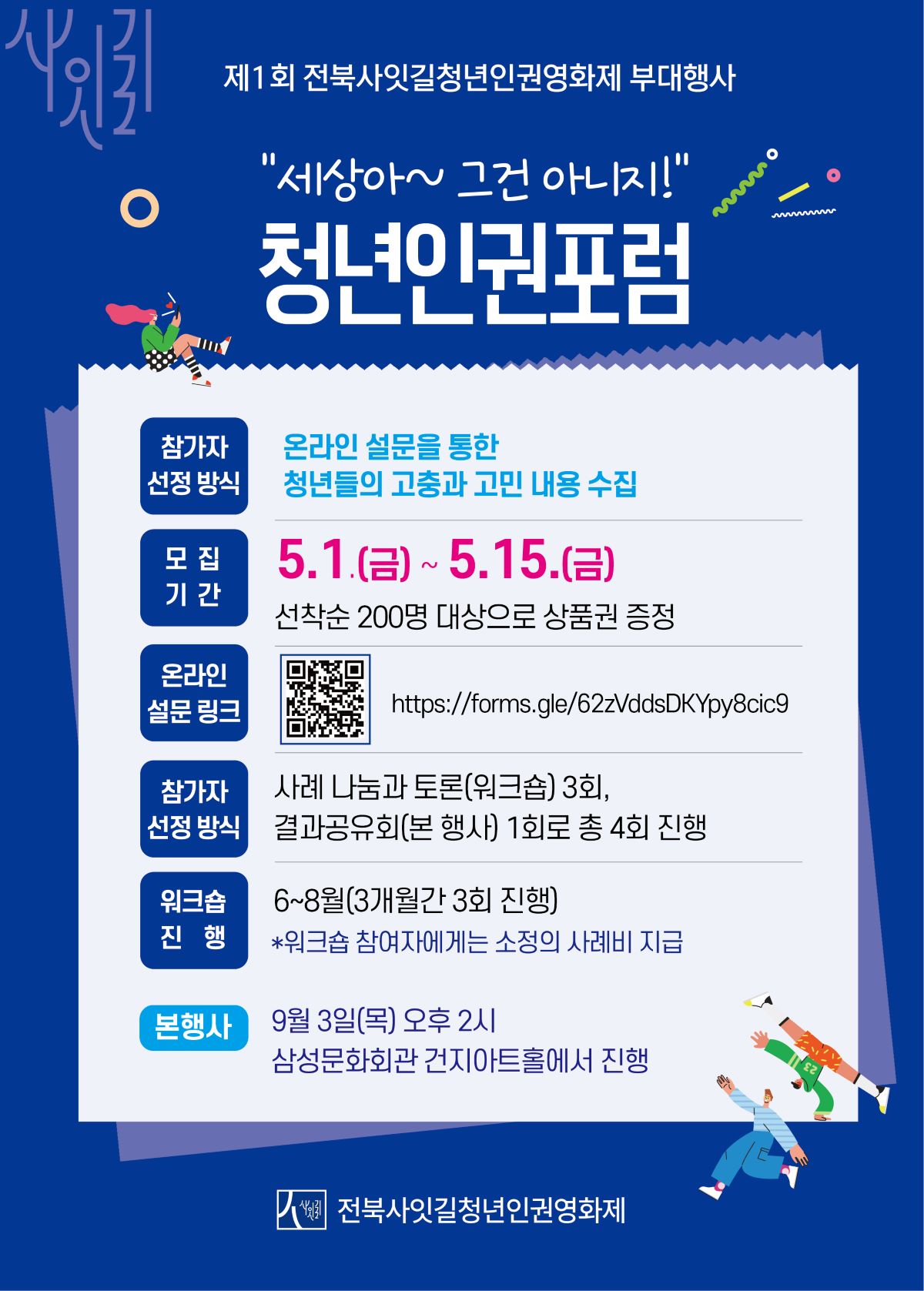
The voices vividly capturing the moments of human rights violations and unfairness faced by young people in the Jeonbuk region in their daily lives have been revealed. The Youth Human Rights Forum, planned as a sub-event of the "Jeonbuk Alleyway Youth Human Rights Film Festival," presented an analysis report of the online survey 'Hey, World~ "That's Not Right"' conducted from May 1st to 15th targeting 180 young people under 40 in the province.
■ 9 out of 10 young people: "The unfairness I experienced is not a personal issue but a 'structural societal problem'"
According to the survey results, workplaces (20.8%) and schools (20.2%) were the places where young people most often felt, "This is not right." Following that, online spaces (12.9%) and public transportation (12.4%) showed that human rights violations were occurring frequently across various areas of young people's daily activities. Notably, 57.9% of respondents clearly defined the unfairness they experienced as a 'societal issue,' with 38.2% stating it was a combination of 'personal and societal issues.' More than 9 out of 10 young people view everyday human rights violations not as individual incidents but as structural contradictions.
■ Age-specific perceptions of cruelty... 30s focus on 'workplace hierarchy,' 20s on 'discrimination in schools and conflicts in public transportation'
The analysis of unfairness faced by young people showed distinct differences by generation.
△ 30s working youth: A whopping 53.6% identified the 'workplace' as a hotbed of human rights violations. Main causes included gender discriminatory remarks in public settings, discrimination based on employment types like contract or temporary positions, and a hierarchical culture that ignores new employees' ideas.
△ 20s university students and job seekers: They felt the most unfairness at school (23.4%). Issues raised included exclusion from group projects based on dialect or speech style, and a judgment culture prioritizing appearance over abilities. They also mentioned conflicts with some elderly passengers in public transportation (14.8%), who demanded seats from young people based solely on their appearance and hurled insults.
△ Teens: 'Home' (18.2%) and 'cafes' (18.2%) tied for the top spot, showing vulnerability to breakdowns in communication at home and insults (bullying) in part-time job settings.
■ Power dynamics, labor, poverty... Key words of unfairness chosen by young people
Young people most frequently associated power dynamics (18%) with the human rights keywords related to their experiences, followed by labor (17%), poverty/inequality (13%), safety (12%), and region (11%).
In detailed responses, examples included behaviors like demanding 'flattery' or 'cuteness' from junior female employees at an event, being criticized for future uncertainty rather than job competency at interviews in the capital region due to being a local youth, and indiscriminate online and offline hate speech and mockery towards foreign laborers or international students.
■ "Empower young people as rightful agents, not passive beneficiaries"... Intended for policy proposals
A representative of the Youth Human Rights Forum emphasized, "Through this survey, it was revealed that young people in Jeonbuk endure complex discrimination within social power dynamics due to reasons like being young, having low job positions, and living in local areas," stressing the urgent need for a societal shift in perception that does not dismiss young people's grievances as 'sensitivity' or 'lack of effort.'
The forum plans to distribute the report based on this survey and conduct workshops to explore concrete alternatives with hopeful young people. Additionally, the identified local community issues will be officially shared with relevant agencies such as the Jeonbuk Provincial Government to be used as foundational data for formulating practical policies to ensure young people's human rights and improve organizational culture.
청년 응답자 중 96.1% “일상 속 인권 침해는 구조적인 사회적 문제”로 인식
전북지역 청년들이 일상생활 속에서 마주하는 인권 침해와 부당함의 순간들을 생생하게 담아낸 목소리가 공개됐다. 「전북 사잇길 청년인권영화제」의 부대행사로 기획된 청년인권포럼은 지난 5월 1일부터 15일까지 도내 40세 미만 청년 180명을 대상으로 진행한 온라인 설문조사 ‘세상아~ “그건 아니지”’의 분석 보고서를 발표했다.
■ 청년 10명 중 9명, “내가 겪은 부당함은 개인 아닌 ‘사회 구조적 문제’”
조사 결과에 따르면, 청년들이 일상에서 “이건 좀 아닌데…”라고 느낀 장소로 직장(20.8%)과 학교(20.2%)가 가장 높은 비율을 차지했다. 이어 온라인 공간(12.9%), 대중교통(12.4%) 순으로 나타나 청년들의 주요 활동 반경 전반에서 인권 침해가 빈번하게 발생하고 있었다.
주목할 점은 응답자의 57.9%가 자신이 겪은 부당함을 ‘사회적 문제’라고 명확히 규정했으며, ‘개인과 사회적 문제가 복합된 것’이라는 응답도 38.2%에 달했다. 청년 10명 중 9명 이상이 일상의 인권 침해를 개인 간의 해프닝이 아닌 구조적 모순으로 바라보고 있는 것이다.
■ 연령별 체감 잔혹사… 30대는 ‘일터 위계’, 20대는 ‘학내 차별 및 대중교통 갈등’
연령대별 교차분석 결과, 청년들이 마주하는 부당함의 공간은 세대별로 뚜렷한 차이를 보였다.
△30대 직장인 청년층: 무려 53.6%가 ‘직장’을 인권 침해의 온상으로 지목했다. 공적인 자리에서의 성차별적 발언, 계약직·기간제에 대한 고용 형태별 차별, 신입사원의 아이디어를 묵살하는 위계 문화가 주된 원인이었다.
△20대 대학생 및 취업준비생층: 학교(23.4%)에서 가장 큰 부당함을 느꼈다. 사투리나 말투를 이유로 조별 과제에서 배제하거나, 능력보다 외모를 우선시하는 품평 문화 등이 고발됐다. 또한 대중교통(14.8%) 내에서 겉모습만 보고 청년에게 자리 양보를 강요하며 폭언을 퍼붓는 일부 장노년층과의 ‘세대 갈등’도 깊은 상처로 남았다고 답했다.
△10대 청년층: 가정(18.2%)과 카페(18.2%)가 공동 1위로 나타나, 가정 내 소통 단절 및 아르바이트 현장에서의 인격 모독(갑질)에 취약한 모습을 보였다.
■ 권력관계·노동·가난… 청년들이 뽑은 부당함의 핵심 키워드
청년들은 본인이 겪은 사례와 연관된 인권 키워드로 권력관계(18%)를 가장 많이 꼽았으며, 노동(17%), 가난/불평등(13%), 안전(12%), 지역(11%)이 그 뒤를 이었다.
구체적인 서술형 답변에서는 "행사 뒷풀이에서 막내 여직원에게 시청 공무원 앞 '헌화주'나 '애교'를 요구하는 행태", "지역 청년이라는 이유로 수도권 면접 현장에서 직무 역량 대신 미래의 불확실성을 지적당하며 하대받은 경험", "외국인 노동자나 유학생을 향한 온·오프라인상의 무차별적 혐오와 조롱" 등의 사례가 있었다.
■ “청년을 시혜적 수혜자 아닌 당당한 주체로”… 정책 제안 자료로 활용 예정
청년인권포럼 관계자는 “이번 조사는 전북 청년들이 ‘나이가 어리고, 직급이 낮고, 지방에 산다’는 이유로 사회적 권력관계 속에서 복합적인 차별을 견디고 있었다”며 “청년의 고충을 개인의 ‘예민함’이나 ‘노력 부족’으로 치부하는 기성사회의 인식 전환이 시급하다”고 강조했다.
포럼 측은 이번 설문 결과를 바탕으로 보고서를 배포하고, 희망하는 청년들과 함께 구체적인 대안을 모색하는 워크숍을 진행할 예정이다. 아울러 도출된 지역사회 의제는 전북특별자치도청 등 관계기관에 공식 공유하여 실질적인 청년 인권 보장 및 조직문화 개선 정책 수립을 위한 기초 자료로 활용할 방침이다.