
As urbanization and development continue to intensify conflicts among residents surrounding the breeding grounds of egrets across the country, voices calling for viewing egrets not as objects of rejection but as neighbors to live together with and find a path of coexistence are growing louder.
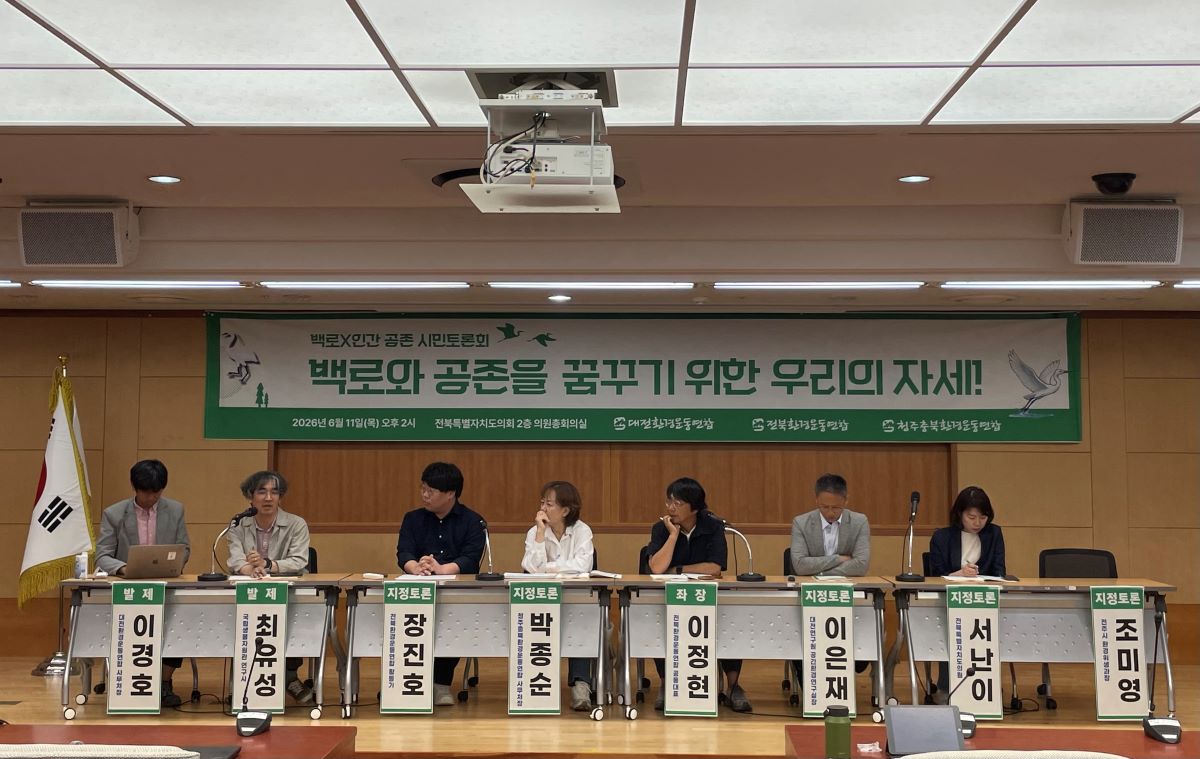
The Jeonbuk Environmental Movement Union, Daejeon Environmental Movement Union, and Cheongju-Chungbuk Environmental Movement Union jointly hosted the "Our Attitude for Dreaming of Coexistence with Egrets! Egrets X Humans Coexistence Citizen Forum" at the Jeonbuk Provincial Council's assembly hall on June 11. This forum was organized to reevaluate the ecological value of egrets and discuss practical coexistence measures between humans and egrets through domestic and international management cases.
Egret habitats being fragmented due to urbanization... "Cutting trees to drive them away only shifts the conflict"
Choi Yoo-sung, a researcher at the National Institute of Biological Resources, who was in charge of the first presentation, pointed out the recent trend of large-scale breeding grounds being damaged or dispersed in small scales due to urbanization, development, and residents' complaints. Choi emphasized that "egrets are closely related to rivers, wetlands, and farmland, and group breeding grounds are indicators of the health of regional ecosystems."
Following this, Lee Kyung-ho, the head of the Daejeon Environmental Movement Union, mentioned conflict cases in Daejeon and Cheongju, criticizing the cutting of habitat trees due to complaints about odor, noise, and excrement. Lee stated, "Such cutting and eviction methods are merely 'passing the egret bomb,' shifting the conflict to another area rather than eliminating egrets," suggesting a policy shift to manage habitats like in Vietnam and Japan and utilize them as ecological assets.
Local issues pouring out... Proposing development regulations and ecological parks as alternatives
The subsequent panel discussion (moderated by Lee Jung-hyun, co-representative of the Jeonbuk Environmental Movement Union) exchanged vivid voices from the field and concrete alternatives.
Realistic complaints and prior coordination: Jo Mi-young, head of the Environmental Hygiene Department in Jeonju, lamented the difficulty of persuading residents, stating, "Comprehensive review and social consensus are necessary." Lee Eun-jae, director of the Daejeon Research Institute, said, "Realistic measures should be taken to identify areas of severe conflict early and naturally guide egrets to move to other places."
Governance and ecological parks: Park Jong-soon, head of the Cheongju-Chungbuk Environmental Movement Union, expressed concerns that egrets displaced by development projects could cluster near the Songjeol-dong residential complex in Cheongju, leading to severe conflicts. Park suggested that establishing a governance structure involving the government, private sector, and civic organizations, along with creating "egret ecological parks" like in Jeonju, could be an alternative solution.
Need for proactive comprehensive surveys: Jang Jin-ho, an activist at the Jeonbuk Environmental Movement Union, acknowledged the ecological value of egret habitats in Jeonju such as Geonji Mountain and Egret Park but warned of potential conflicts due to odor and dust. Jang emphasized the necessity of conducting comprehensive surveys and discussing proactive management measures for Jeonju's regional group breeding grounds before conflicts escalate.
Enhancing institutional sanctions: Seo Nan-yi, a member of the Jeonbuk Provincial Council, stressed the need for strong sanctions and social discourse, such as conditional development restrictions, for undeveloped areas without habitat protection measures even before legalization.
Expanding to a East Asia coexistence model with Korea, Japan, and Vietnam
During the forum, experiences were shared on how conflicts over egret breeding grounds at KAIST were alleviated through on-site ecological education, highlighting the importance of education and promotion once again.
Concluding the forum, co-representative Lee Jung-hyun stated, "Eliminating egret breeding grounds will not solve the problem," suggesting that "administrative bodies, civil society, and experts should gather wisdom to create urban ecosystems where people and wildlife can live together."
Meanwhile, the three branches of the Environmental Movement Union that organized this forum plan to launch an 'International Forum' in the future with researchers and civic organizations from Korea, Japan, and Vietnam participating. Through this, they aim to share each country's habitat management experiences and build a 'East Asia Coexistence Model,' recognizing egrets as neighbors of coexistence.
“백로는 쫓아낼 대상 아닌 이웃”... ‘백로X인간’ 공존 해법 모색
도시화와 개발로 인해 전국 곳곳에서 백로 집단번식지를 둘러싼 주민 갈등이 심화되는 가운데, 백로를 배척의 대상이 아닌 함께 살아갈 이웃으로 바라보고 상생의 길을 찾아야 한다는 목소리가 커지고 있다.
전북환경운동연합, 대전환경운동연합, 청주충북환경운동연합은 지난 6월 11일 전북특별자치도의회 의원총회의실에서 「백로와 공존을 꿈꾸기 위한 우리의 자세! 백로X인간 공존 시민토론회」를 공동 개최했다. 이번 토론회는 백로의 생태적 가치를 재조명하고, 국내외 관리 사례를 통해 인간과 백로의 실질적인 공존 방안을 논의하기 위해 마련됐다.
도시화로 쪼개지는 백로 서식지... "나무 베는 퇴치는 갈등 옮기기일 뿐"
첫 번째 발제를 맡은 최유성 국립생물자원관 연구사는 ‘한국의 백로 집단서식지 현황’을 발표하며, 최근 도시화와 개발, 주민 민원으로 인해 대규모 번식지가 훼손되거나 소규모로 분산되는 경향을 지적했다. 최 연구사는 "백로류는 하천, 습지, 농경지와 밀접한 생물로, 집단번식지는 지역 생태계의 건강성을 보여주는 지표"라고 강조했다.
이어 이경호 대전환경운동연합 사무처장은 대전과 청주의 갈등 사례를 언급하며 악취, 소음, 배설물 민원으로 인해 서식지 나무를 벌목하는 행태를 비판했다. 이 처장은 "이러한 벌목과 퇴치 방식은 백로를 없애는 것이 아니라 다른 지역으로 갈등을 옮기는 '백로 폭탄돌리기'에 불과하다"며, 베트남과 일본처럼 서식지를 관리하고 생태 자산으로 활용하는 공존 전제의 정책 전환이 필요하다고 제안했다.
지역별 현안 분출... 개발 규제와 생태 공원 등 대안 제시
이어진 지정토론(좌장 이정현 전북환경운동연합 공동대표)에서는 현장의 생생한 목소리와 구체적인 대안들이 오갔다.
현실적 민원과 사전 조율: 조미영 전주시 환경위생과장은 주민 설득의 어려움을 토로하며 "종합적인 검토와 사회적 합의가 필요하다"고 밝혔고, 이은재 대전연구원 실장은 "민원 발생 조기에 피해 지역을 파악해 심한 갈등이 예상되는 곳은 자연스럽게 다른 곳으로 이동하도록 유도하는 현실적 방안이 병행돼야 한다"고 말했다.
거버넌스와 생태 공원: 박종순 청주충북환경운동연합 사무처장은 개발 사업으로 인해 서식처를 잃은 백로들이 송절동 주택단지 옆으로 밀집해 극심한 갈등이 예상된다고 우려했다. 박 처장은 "행정·민간·시민단체가 참여하는 거버넌스 구성과 함께 전주 사례와 같은 '백로 생태 공원' 조성이 대안이 될 수 있다"고 제안했다.
선제적 전수조사 필요성: 장진호 전북환경운동연합 활동가는 건지산과 백로공원 등 전주 지역 서식지의 생태적 가치를 인정하면서도, 악취와 분진으로 인한 잠재적 갈등을 경고했다. 장 활동가는 "갈등이 표면화되기 전에 전주 권역 집단번식지에 대한 전수조사와 선제적 관리 방안을 논의해야 한다"고 역설했다.
제도적 제재 강화: 서난이 전북특별자치도의원은 법제화 이전이라도 서식지 보호 대책이 마련되지 않은 개발 행위에 대해서는 "조건부 개발 제한 등 강한 제재와 사회적 공론화가 필요하다"고 강조했다.
한·일·베 동아시아 공존 모델로 확대 나선다
이날 청중석에서는 카이스트 교내 백로 번식지 갈등을 현장 생태 교육으로 완화했던 실제 경험담이 공유되며 교육과 홍보의 중요성이 다시 한번 부각되기도 했다.
토론회를 마무리하며 이정현 공동대표는 "백로 번식지를 없애는 방식으로는 문제를 해결할 수 없다"라며 "사람과 야생생물이 함께 살아갈 수 있는 도시 생태계 조성을 위해 행정, 시민사회, 전문가가 지혜를 모아야 한다"고 제언했다.
한편, 이번 토론회를 개최한 환경운동연합 3개 지부는 이번 논의를 시작으로 향후 한국, 일본, 베트남의 연구자와 시민단체가 참여하는 '국제포럼'을 추진할 계획이다. 이를 통해 각국의 서식지 관리 경험을 공유하고, 백로를 공존의 이웃으로 인식하는 '동아시아 공존 모델'을 구축해 나갈 예정이다.