
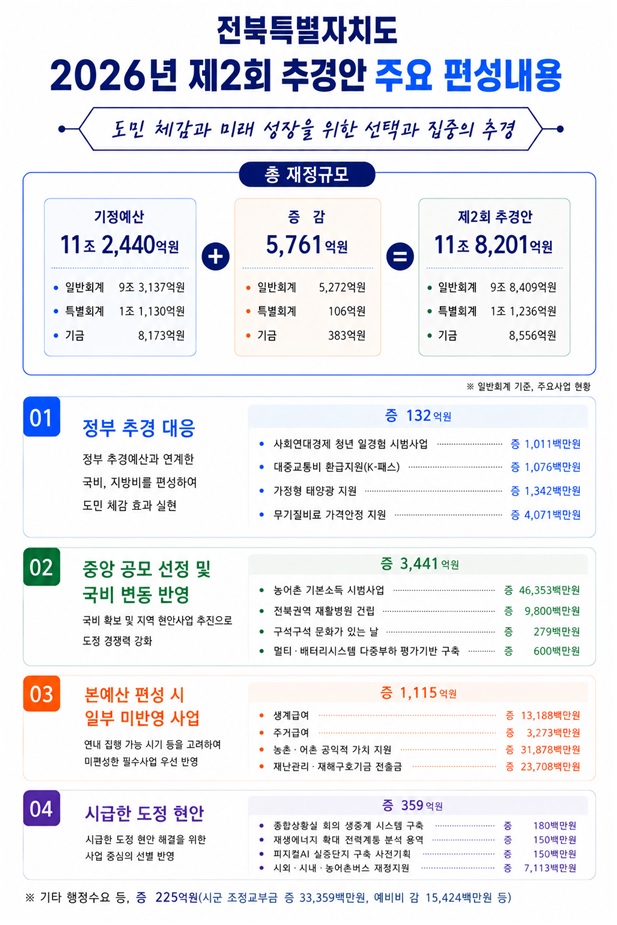
Jeonbuk Special Self-Governing Province has prepared the second supplementary budget proposal for the year 2026, amounting to 11 trillion 8,201 billion won, which was submitted to the provincial council. This is an increase of 576.1 billion won, or 5.1%, from the original budget of 11 trillion 2,440 billion won.
By account, the general account increased by 527.2 billion won to 9 trillion 8,409 billion won, while the special account increased by 106 billion won to 1 trillion 1,236 billion won. The funds also increased by 383 billion won to 8,556 billion won.
Jeonbuk Province explained that the focus of this supplementary budget is on responding to the government's supplementary budget, selecting projects in cooperation with central ministries, reflecting local expenses due to changes in national funding, and allocating funds for essential projects that were not fully included in the original budget. However, as the province's own revenue conditions are not sufficient, it has decided to issue local bonds worth 150 billion won, which will remain a challenge for future financial soundness management.
The supplementary budget also includes budgets related to disabilities and welfare. A budget of 98 billion won has been allocated for the construction of a rehabilitation hospital in the Jeonbuk region. This project aims to expand medical rehabilitation infrastructure for residents in the province who are disabled, severely ill, or in need of rehabilitation treatment after accidents or illnesses. If the rehabilitation hospital is implemented as planned, it is expected to improve access to rehabilitation treatment within the province and alleviate the burden of long-distance medical care.
Budgets for low-income household stability include 131.88 billion won for livelihood support and 32.73 billion won for housing support. Livelihood support is a budget for ensuring the minimum living standards of basic livelihood security recipients, while housing support is for assisting low-income households with rent and housing repairs. Given the ongoing high prices and housing cost burdens, these support budgets are expected to function effectively for vulnerable groups.
A budget of 318.78 billion won has been allocated for supporting public interest projects in rural and fishing villages. This budget, which serves as an agricultural community welfare allowance, is expected to contribute to maintaining the income and community cohesion of rural residents. The pilot project for basic income in rural areas, amounting to 463.53 billion won, is also included, which is expected to assess the effectiveness of policies for addressing regional depopulation and stabilizing rural livelihoods.
Additionally, the budget for disaster management and relief funds has been increased by 237.8 billion won. Although not directly related to welfare benefits, this budget is used for disaster recovery and emergency relief in times of disasters, which is significant for protecting vulnerable groups and enhancing social safety nets.
In response to the government's supplementary budget, various projects have been included, such as 40.71 billion won for stabilizing prices of inorganic fertilizers, 13.42 billion won for supporting household solar power systems, 10.76 billion won for public transportation fare refunds, and 10.11 billion won for a pilot project on youth experiences in social solidarity economy.
Projects selected in cooperation with central ministries and reflecting changes in national funding include the pilot project for basic income in rural areas, the construction of a rehabilitation hospital in the Jeonbuk region, cultural events in every nook and cranny, and the establishment of a multi-battery system multi-load evaluation base.
Urgent provincial affairs included in the budget are 71.13 billion won for financial support for intercity, intracity, and rural buses, 18 billion won for establishing a live broadcasting system for comprehensive situation rooms, 15 billion won for analyzing strategic plans for expanding renewable energy, and 15 billion won for pre-planning the establishment of a Physical AI demonstration site.
While the necessity of this supplementary budget is acknowledged for reflecting livelihood, welfare, and national funding-related projects, the effectiveness of budget execution and future debt management should be jointly reviewed, especially considering the issuance of local bonds for funding. It is crucial that the speed of project implementation and budget management are prioritized to ensure that welfare and rehabilitation-related budgets effectively lead to improved medical accessibility, stability in livelihoods, and protection of vulnerable groups among residents.
Governor Lee Won-taek of Jeonbuk Special Self-Governing Province stated, "This supplementary budget was prepared with a focus on essential projects even under difficult financial conditions," and added, "We will operate the budget responsibly, and the promises of the 9th local government will be gradually implemented starting from next year's original budget after thorough consideration."
The supplementary budget proposal will undergo proposal explanations on the 16th and be reviewed by the provincial council from the 16th to the 30th.
전북자치도, 제2회 추경 11조8,201억 원 편성…복지·재활 예산 반영, 지방채 1,500억 원 발행
전북특별자치도가 2026년도 제2회 추가경정예산안을 11조8,201억 원 규모로 편성해 도의회에 제출했다. 이는 기정예산 11조2,440억 원보다 5,761억 원, 5.1% 증가한 규모다.
회계별로는 일반회계가 9조8,409억 원으로 5,272억 원 늘었고, 특별회계는 1조1,236억 원으로 106억 원 증가했다. 기금은 8,556억 원으로 383억 원 늘었다.
전북자치도는 이번 추경에 대해 정부 추경 대응, 중앙부처 공모사업 선정, 국비 내시 변경에 따른 지방비 반영, 본예산에 일부 반영하지 못한 필수사업 편성에 중점을 뒀다고 설명했다. 다만 자체 세입 여건이 충분하지 않은 상황에서 1,500억 원 규모의 지방채를 발행하기로 해 향후 재정 건전성 관리도 과제로 남게 됐다.
이번 추경에는 장애인 및 복지 관련 예산도 포함됐다. 전북권역 재활병원 건립 사업에는 98억 원이 반영됐다. 이 사업은 장애인과 중증질환자, 사고나 질병 이후 재활치료가 필요한 도민을 위한 의료재활 인프라 확충 사업이다. 재활병원이 계획대로 추진될 경우 도내 재활치료 접근성 개선과 장거리 진료 부담 완화에 도움이 될 것으로 보인다.
저소득층 생활 안정을 위한 예산으로는 생계급여 131억8,800만 원, 주거급여 32억7,300만 원이 추가 편성됐다. 생계급여는 기초생활보장 수급자의 최저생활 보장을 위한 예산이고, 주거급여는 저소득층의 임차료와 주택 수선 등을 지원하는 사업이다. 고물가와 주거비 부담이 이어지는 상황에서 취약계층 지원 예산으로 기능할 것으로 예상된다.
농촌·어촌 공익적 가치 지원 사업에는 318억7,800만 원이 반영됐다. 이 예산은 농어민 공익수당 성격으로, 농어촌 주민의 소득 보전과 지역 공동체 유지에 일정 부분 기여할 것으로 보인다. 농어촌 기본소득 시범사업 463억5,300만 원도 포함돼 지역소멸 대응과 농어촌 생활 안정 정책의 효과를 가늠하는 사업이 될 전망이다.
재난관리·재해구호기금 전출금 237억800만 원도 증액됐다. 이는 직접적인 복지급여는 아니지만, 재난 발생 시 피해 복구와 긴급구호에 활용되는 예산으로, 취약계층 보호와 사회안전망 강화 측면에서 의미가 있다.
정부 추경 대응 분야에는 무기질비료 가격안정 지원 40억7,100만 원, 가정형 태양광 지원 13억4,200만 원, 대중교통비 환급지원 10억7,600만 원, 사회연대경제 청년 일경험 시범사업 10억1,100만 원 등이 포함됐다.
중앙 공모 선정 및 국비 변동 반영 분야에는 농어촌 기본소득 시범사업, 전북권역 재활병원 건립, 구석구석 문화가 있는 날, 멀티·배터리시스템 다중부하 평가기반 구축 사업 등이 반영됐다.
시급한 도정 현안으로는 시외·시내·농어촌버스 재정지원 71억1,300만 원, 종합상황실 회의 생중계시스템 구축 1억8,000만 원, 재생에너지 확대 전략계획 분석 용역 1억5,000만 원, 피지컬AI 실증단지 구축 사전기획 1억5,000만 원 등이 편성됐다.
이번 추경은 민생·복지와 국비 연계사업을 반영했다는 점에서 필요성이 인정되지만, 지방채 발행을 통한 재원 조달이라는 점에서 예산 집행의 실효성과 향후 채무 관리가 함께 점검돼야 한다. 특히 복지와 재활 관련 예산이 실제 도민의 의료 접근성, 생활 안정, 취약계층 보호로 이어지기 위해서는 사업 추진 속도와 집행 관리가 중요할 것으로 보인다.
이원택 전북특별자치도지사는 “이번 추경은 어려운 재정 여건 속에서도 꼭 필요한 사업을 중심으로 편성했다”며 “재정은 책임감 있게 운영하고, 민선 9기 공약은 충분한 검토를 거쳐 내년도 본예산부터 단계적으로 추진하겠다”고 말했다.
이번 추경안은 오는 16일 제안설명을 거쳐 16일부터 30일까지 도의회 심의를 받는다.