
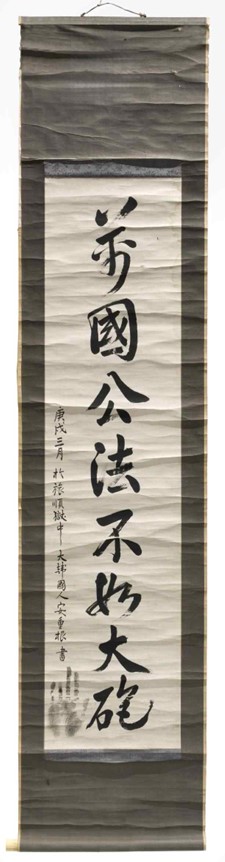
The Cultural Heritage Administration (Director Heo Min) will unveil the
"The International Law is No Match for Cannons" conveys the meaning that "international law is not as powerful as cannons." This manuscript reflects deeply on the skepticism of An Jung-geun, who received a death sentence in February 1910 in the Lushun Prison in China, regarding the ineffectiveness of international law.
As can be seen through the "Theory of Oriental Peace" written by An Jung-geun in Lushun Prison, An emphasized the maintenance of peace and order in the East according to the international law. Even after assassinating Ito Hirobumi at Harbin Station in China on October 26, 1909, he claimed that he had carried out a legitimate act of war as a staff officer of the Korean Army and demanded a trial according to international law. However, Japan did not accept this and sentenced An Jung-geun to death on a simple charge of murder. The eight characters of "The International Law is No Match for Cannons" directly reflect this reality and perception.
안중근 의사가 옥중에서 쓴 ‘만국공법불여대포(萬國公法不如大砲)’ 유묵, 국내 귀환
국가유산청(청장 허민)은 광복절을 앞두고 13일 오전 10시 30분 덕수궁 중명전에서 국외소재문화유산재단과 함께 일본에서 환수한 <안중근의사 유묵 – 만국공법불여대포(萬國公法不如大砲)>(이하 ‘만국공법불여대포’)를 언론에 최초로 공개한다.
<만국공법불여대포>는 ‘만국공법(萬國公法), 즉 국제법이 대포(大砲)만 못하다’는 뜻을 담고 있다. 이 유묵은 1910년 2월 중국 뤼순감옥에서 사형 선고를 받은 안중근 의사가 느낀 국제법의 무력함에 대한 깊은 회의를 고스란히 담고 있다.
안중근 의사가 뤼순감옥에서 집필한 『동양평화론』을 통해서도 알 수 있듯이, 안 의사는 만국공법에 따른 동양의 평화와 질서 유지를 주장했다. 1909년 10월 26일 중국 하얼빈역에서 이토 히로부미를 저격한 이후에도, 그는 대한의군(大韓義軍) 참모중장의 자격으로 정당한 전쟁 행위를 수행한 것이라 주장하며 만국공법에 따른 재판을 요구했다. 그러나 일본은 이를 받아들이지 않고 안중근 의사를 단순 살인죄로 기소해 사형을 구형했다. ‘만국공법불여대포’ 여덟 글자에는 이러한 현실에 대한 인식이 그대로 반영돼 있다.