
Calls have been made to strengthen protective measures to prevent retaliatory disciplinary actions and personnel disadvantages against public interest whistleblowers in private schools, and to transfer disciplinary reviews of private school teachers to the education authorities.
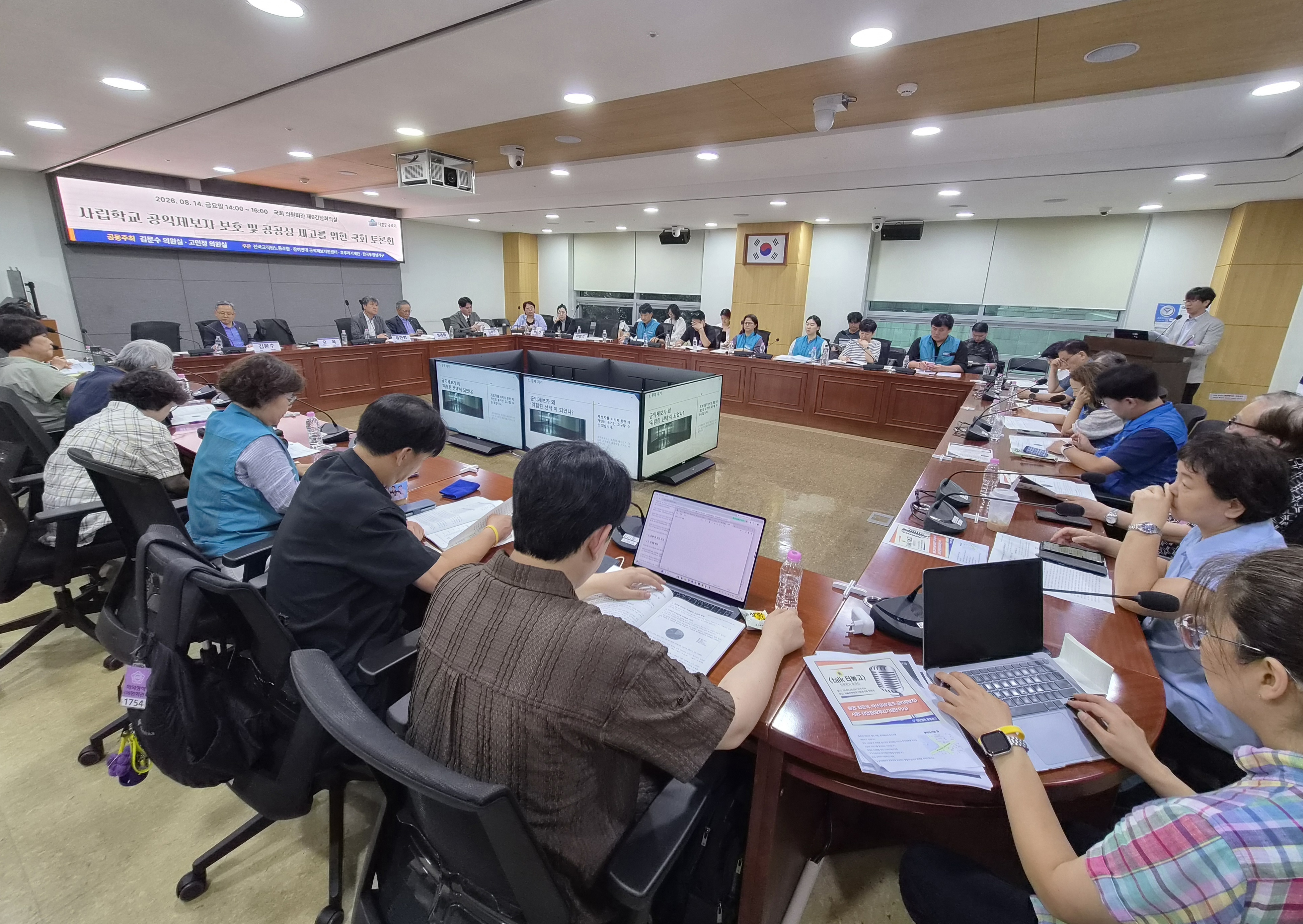
The National Teachers Union (Chairman Park Young-hwan) held a forum titled 'National Assembly Symposium on Improving the Private School Law and System for Enhancing Publicness and Transparency in Private Schools for the Protection of Public Interest Reporters' in the 9th conference room of the National Assembly Members' Office at 2 p.m. on the 14th, in collaboration with the Participatory Solidarity Public Interest Reporting Support Center, Transparency International Korea, and the Horuragi Foundation.
At the symposium, co-hosted by Kim Moon-soo and Ko Min-jeong's parliamentary offices, the limitations of the protection system for public interest whistleblowers in private schools were examined, and ways to improve laws and systems to enhance the publicness and transparency of private school operations were discussed.
The symposium was organized following the death of a teacher who reported irregularities in a private high school in Icheon, Gyeonggi Province in May, where embezzlement of approximately 3 billion won from the school corporation was confirmed during an audit by the Gyeonggi Provincial Office of Education.
Participants diagnosed the incident not as an exceptional problem at one school, but as a structural issue where public interest whistleblowers are not protected, and the management and supervision of private schools by educational authorities are not functioning properly.
"73.9% of teachers find it difficult to report public interest due to fear of disadvantages," said Chairman Park Young-hwan of the National Teachers Union, emphasizing that the disciplinary actions, isolation, and repeated disadvantages that followed the reporting of irregularities are typical retaliatory measures against public interest whistleblowers.
Chairman Park stressed, "As private schools are responsible for public education, private school teachers should receive fair personnel management and protection similar to public school teachers," and emphasized the need to strengthen the authority of educational authorities for management and supervision and to revise the Private School Law to effectively protect public interest whistleblowers.
The first presenter, Oh Wook, former chairman of the National Teachers Union, announced the results of a survey conducted on 2,388 private school teachers nationwide.
According to the survey results, 73.9% of respondents stated that they find it difficult to report public interest due to concerns about personal disadvantages. 48% responded that they have directly experienced or witnessed retaliatory disciplinary actions, targeted personnel decisions, lawsuits, and complaints after reporting public interest or refusing unfair instructions.
80.3% of respondents stated that the Teacher Personnel Committee does not function as an independent body to curb the abuse of personnel authority by school principals. 88.7% of respondents also stated that the Teacher Disciplinary Committee does not function as an effective mechanism to prevent retaliatory or excessive disciplinary actions.
Oh, the chairman, proposed measures for improvement, including prohibiting disadvantages against public interest whistleblowers, introducing the authority for temporary suspension and restoration orders by the relevant education authorities, democratizing the Teacher Personnel Committee, and transferring the disciplinary review of elementary and secondary private school teachers to the education authorities.
"Autonomy of academia distorted into autonomy of foundations"
The second presenter, Jung Dae-hwa, a member of the Private School Conflict Resolution Committee, emphasized that issues in academia should be approached from the perspective of operational structure and the publicness of education, rather than individual irregularities.
Jung pointed out that the autonomy of academia has been distorted into the 'autonomy of foundations' rather than the autonomy of schools and education. It is necessary to view academia as a public asset responsible for public education, not as intellectual property.
Jung proposed restructuring the board into a structure that can guarantee public interest and increasing transparency in operations and finances. The board should be responsible for the medium to long-term development and financial operation of the school, the election of the school principal, but the personnel authority over the faculty should be delegated to the school, Jung argued.
Furthermore, a new social consensus is needed to strengthen the financial responsibility of the state and the public nature and duty of academia, Jung emphasized.
"Retaliatory lawsuits should also be included in retaliatory measures"
In the designated discussions, there was a consensus on the need for practical protective measures for public interest whistleblowers.
Lee Young-ki, director of the Horuragi Foundation, pointed out that the current scope of application of the Public Interest Whistleblower Protection Act and regulations on retaliatory measures alone are insufficient to adequately protect public interest whistleblowers in private schools.
Lee suggested expanding the laws targeting public interest disclosures and the scope of public interest violations, and including lawsuits and civil litigation aimed at pressuring whistleblowers in retaliatory measures. Lee also stated that the Private School Law should include provisions prohibiting harassment of public interest whistleblowers within the workplace, strengthening the independence of the Teacher Personnel Committee and the Disciplinary Committee, and increasing the effectiveness of canceling approval for the appointment of school corporation executives.
Park Eun-seon, a member of the Participatory Solidarity Public Interest Reporting Support Center, evaluated the significance of this survey in confirming statistically the 'structure of fear' among teachers who fear disadvantages after public interest reporting.
Park proposed that the prohibition of retaliatory measures against public interest whistleblowers should be codified in the Private School Law, and a system of enforcement fines should be introduced to enforce immediate protective measures and restoration. Park also suggested electing all members of the Teacher Personnel Committee from the faculty council and mandating the mandatory inclusion of standard operating regulations prepared by the relevant education authorities in the school regulations. The disciplinary review of private school teachers should be transferred to the Education Public Servants Disciplinary Committee, and the protection of temporary teachers and the expansion of legal support for public interest whistleblowers' litigation costs should also be increased, Park added.
"Disciplinary authority used as a means to pressure teachers who raise issues"
Kang So-yeon, a field teacher, pointed out that retaliatory disciplinary actions and personnel disadvantages have been repeated against teachers who report public interest or raise issues in school operations at private schools, and many cases are still unresolved.
Kang stated, "Once retaliatory measures begin, it becomes difficult for teachers, students, and educational activities to recover," emphasizing the need for mechanisms to swiftly halt personnel and disciplinary procedures related to public interest reporting.
In particular, Kang emphasized that the disciplinary authority of private schools can be 'weaponized' as a means to pressure or silence teachers who raise issues, and to prevent this, the disciplinary review of private school teachers should be transferred to the education authorities.
Kang Hye-seung, the Seoul representative of the Participatory Education Parents Association, pointed out that despite receiving significant public funding, private schools monopolize disciplinary authority, and teachers who raise issues are embroiled in disciplinary actions and lawsuits for extended periods.
Kang suggested expanding practical protection such as legal and financial support for public interest whistleblowers even after reinstatement. Protecting public interest whistleblowers and ensuring fair personnel and disciplinary procedures are not just systems for teachers but are basic conditions to maintain a stable educational environment for students and the trust of parents in schools, Kang emphasized.
"Causal relationship between reporting and retaliatory measures should be presumed"
Kim Beom-joo, a legislative researcher at the National Assembly Legislative Research Service, presented legal and procedural issues that need to be addressed for the proposed improvements to lead to actual legislation.
Kim stated that the scope of reports recognized as public interest whistleblowing should be clarified, and regulations should be established to allow for the legal presumption of a causal relationship between reporting and subsequent retaliatory measures to reduce the burden of proof on whistleblowers.
Kim proposed granting the right to apply for protective measures to the parties involved, not solely relying on the authority of the relevant education authorities, and stipulating the application processing deadline and obligation to notify results in the law. Effective sanctions such as enforcement fines are necessary for swift restoration, Kim added.
However, to transfer the disciplinary review of private school teachers to the education authorities, comprehensive design is required, including investigations into disciplinary reasons, data acquisition methods, coordination with the protection procedures for public interest whistleblowers, and the objection and retrial procedures of school corporations, Kim pointed out.
The National Teachers Union urged, "Protecting public interest whistleblowers is not just about protecting one teacher but about safeguarding students' right to education, the publicness of schools, and the societal trust in public education," calling on the National Assembly and the government to take action to amend the Private School Law for the substantial protection of public interest teachers and the democratic operation of the Teacher Personnel Committee and the transfer of the disciplinary review of private school teachers to the education authorities.
"Controversy over biased composition of the Wan-san Foundation's temporary board"
The issues of the publicness of academia and the control of personnel and disciplinary authority raised at the symposium are also related to the case of the Wan-san Foundation in Jeonbuk Province.
After irregularities involving embezzlement and bribery amounting to tens of billions of won by the founders were revealed, the Wan-san Foundation, which operates Wan-san Middle School and Wan-san Girls' High School, was converted to a temporary board system in accordance with a decision by the Ministry of Education's Private School Conflict Resolution Committee in 2019. However, it has not been normalized for over seven years.
The current temporary board is composed of third-term temporary directors appointed by the Ministry of Education's Private School Conflict Resolution Committee in October 2024, following the recommendation of the former Jeonbuk Superintendent of Education at the time of Seo Geoseok's passing.
Seo, the former superintendent, was prosecuted for disseminating false information during the 2022 superintendent election process and was fined 5 million won by the Supreme Court on June 26, 2025, leading to the revocation of his superintendent position. As the temporary board recommended during Seo's tenure is embroiled in several controversies surrounding personnel and operational matters, questions about the fairness of the recommendation and appointment procedures have resurfaced.
Among the Wan-san Foundation's teaching staff, concerns have been raised about the biased composition of the board. The eight temporary directors notified by the Private School Conflict Resolution Committee were classified into four education sector representatives and one each from civil society organizations, media, legal professions, and medical fields. However, the teaching staff argue that out of the five members, including the chairman, five have a background of working in the same education-related civil society organization, indicating that individuals from specific organizations dominate the board's decision-making process.
This composition weakens internal oversight and balance within the board, raising concerns that specific personal relationships or positions may excessively influence decision-making.
"The legitimacy of teacher personnel transfers was claimed but overturned in the appeals process"
Personnel matters within the Wan-san Foundation's board have also sparked controversy. The board claimed that a specific teacher's personnel transfer was an 'exercise of legitimate personnel authority,' and classified objections to this as false claims, even revealing plans for legal action.
However, the Education Ministry's Teacher Appeals Review Committee overturned the personnel transfer decision. It has been confirmed that the Jeonbuk Provincial Office of Education issued corrective orders following the Teacher Appeals Review Committee's decision. The reason for the need for management and supervision by educational authorities regarding whether the board's personnel authority exercise was appropriate is due to this.
The Wan-san Foundation case demonstrates that even under a temporary board system, the publicness and transparency of academia are not automatically guaranteed. If even the temporary board dispatched to correct irregularities is not free from controversies over biased composition and personnel authority exercise, there is a need to establish institutional control mechanisms that do not rely on specific individuals or the board's judgments.
Therefore, demands for codifying democratic composition and independence of the Teacher Personnel Committee, transferring the disciplinary review of private school teachers to the education authorities, and immediate cessation and restoration orders for personnel and disciplinary disadvantages against public interest whistleblowers need to be enshrined in the Private School Law, gaining more persuasive power.
사립학교 공익제보자 보호 강화 촉구…“징계 심의 교육청 이관해야”
전교조 등 국회 토론회서 사립학교법 개정 제안 완산학원 임시이사회도 특정단체 출신 편중·인사권 남용 논란
사립학교 공익제보자가 보복성 징계와 인사상 불이익을 받지 않도록 보호조치를 강화하고, 사립교원에 대한 징계 심의를 교육청으로 이관해야 한다는 주장이 제기됐다.
전국교직원노동조합(위원장 박영환)은 14일 오후 2시 국회의원회관 제9간담회의실에서 참여연대 공익제보지원센터, 한국투명성기구, 호루라기재단과 공동으로 ‘사립학교 공익신고자 보호 및 공공성과 투명성 제고를 위한 사립학교법·제도 개선 국회 토론회’를 개최했다.
김문수·고민정 국회의원실이 공동주최한 이번 토론회에서는 사립학교 공익제보자 보호제도의 한계를 점검하고, 사학 운영의 공공성과 투명성을 높이기 위한 법·제도 개선 방안이 논의됐다.
토론회는 지난 5월 경기 이천의 한 사립고등학교에서 학교법인 비리를 공익제보한 교사가 징계와 고립, 반복된 불이익을 겪은 끝에 숨진 사건을 계기로 마련됐다. 경기도교육청 감사에서는 해당 학교법인의 약 30억 원 규모 공금 횡령이 확인됐다.
참석자들은 이 사건을 한 학교에서 발생한 예외적인 문제가 아니라, 공익제보자를 보호하지 못하고 사립학교에 대한 교육당국의 관리·감독도 제대로 작동하지 않는 구조적 문제로 진단했다.
“교원 73.9%, 불이익 우려로 공익제보 어려워”
박영환 전교조 위원장은 “공익제보 교사의 죽음을 개인적 비극으로만 치부해서는 안 된다”며 “비리를 제보한 뒤 징계와 고립, 반복된 불이익이 이어진 것은 공익제보자에게 가해져 온 전형적인 보복 조치”라고 지적했다.
박 위원장은 “사립학교도 공교육을 담당하는 만큼 사립교원 역시 국공립 교원과 마찬가지로 공정한 인사와 신분 보호를 받아야 한다”며 “교육당국의 관리·감독 권한을 강화하고 공익제보자를 실질적으로 보호하도록 사립학교법을 개정해야 한다”고 강조했다.
첫 번째 발제를 맡은 오욱 전교조 사립위원장은 전국 사립학교 교원 2,388명을 대상으로 진행한 실태조사 결과를 발표했다.
조사 결과 응답자의 73.9%는 신분상 불이익에 대한 우려 때문에 공익제보가 어렵다고 답했다. 48%는 공익제보를 하거나 부당한 지시를 거부한 뒤 보복성 징계, 표적 인사, 고소·고발 등의 불이익을 직접 경험하거나 목격했다고 응답했다.
교원인사위원회가 학교장의 인사권 남용을 견제하는 독립적 기구로 기능하지 못한다는 응답은 80.3%였다. 교원징계위원회가 보복성 또는 과도한 징계를 막는 실질적인 장치로 기능하지 못한다는 응답도 88.7%에 달했다.
오 위원장은 제도 개선 과제로 공익제보자에 대한 불이익조치 금지, 관할 교육청의 절차 일시정지 및 원상회복 명령권 도입, 교원인사위원회의 민주적 구성, 초·중등 사립교원 징계 심의의 교육청 이관 등을 제안했다.
“사학의 자율성이 재단의 자율성으로 왜곡”
두 번째 발제를 맡은 정대화 사립학교분쟁조정위원회 위원은 사학 문제를 개별 비리가 아닌 운영 구조와 교육의 공공성이라는 관점에서 접근해야 한다고 밝혔다.
정 위원은 사학의 자율성이 학교와 교육의 자율성이 아니라 ‘재단의 자율성’으로 왜곡돼 왔다고 지적했다. 사학을 사유재산이 아닌 공교육을 담당하는 공공재로 바라봐야 한다는 것이다.
정 위원은 이사회를 공익성을 보장할 수 있는 구조로 재편하고 운영과 재정의 투명성을 높여야 한다고 제안했다. 이사회는 학교의 중장기 발전과 재정 운영, 학교장 선출을 담당하되 교직원에 대한 인사권은 학교에 위임하는 방향으로 역할을 재조정해야 한다고 주장했다.
아울러 국가의 재정적 책임과 사학의 공공성·책무성을 함께 강화하는 새로운 사회적 합의가 필요하다고 강조했다.
“보복성 소송도 불이익조치에 포함해야”
지정토론에서도 공익제보자에 대한 실질적인 보호장치가 필요하다는 의견이 이어졌다.
이영기 호루라기재단 이사장은 현행 공익신고자보호법의 적용 범위와 불이익조치 규정만으로는 사립학교 공익제보자를 충분히 보호하기 어렵다고 지적했다.
이 이사장은 공익신고 대상 법률과 공익침해행위의 범위를 확대하고, 제보자를 압박하기 위한 고소·고발과 민사소송도 불이익조치에 포함해야 한다고 제안했다. 사립학교법에도 공익제보자에 대한 직장 내 괴롭힘 금지, 교원인사위원회와 징계위원회의 독립성 강화, 학교법인 임원취임 승인취소의 실효성을 높이는 규정을 마련해야 한다고 밝혔다.
박은선 참여연대 공익제보지원센터 위원은 이번 실태조사가 공익제보 이후 불이익을 우려하는 교사들의 ‘두려움의 구조’를 통계로 확인했다는 점에서 의미가 있다고 평가했다.
박 위원은 공익제보자에 대한 불이익조치 금지를 사립학교법에 명문화하고, 형사처벌뿐 아니라 즉각적인 보호조치와 원상회복을 강제할 수 있도록 이행강제금 제도를 도입해야 한다고 제안했다.
또한 교원인사위원 전원을 교직원회의에서 선출하고, 관할 교육청이 마련한 표준운영규정을 학교 정관에 의무적으로 반영하도록 해야 한다고 밝혔다. 사립교원 징계 심의를 교육청 교육공무원징계위원회로 이관하고, 기간제 교원 보호와 공익제보자의 소송비용 지원도 확대해야 한다고 덧붙였다.
“징계권이 문제 제기한 교사 압박 수단으로 사용”
강소연 현장교사는 사립학교에서 공익제보나 학교 운영에 대한 문제 제기 이후 보복성 징계와 인사상 불이익이 반복되고 있으며, 상당수 사건이 현재도 해결되지 않고 있다고 지적했다.
강 교사는 “불이익조치가 시작되면 교사뿐 아니라 학생과 교육활동에도 회복하기 어려운 피해가 발생한다”며 공익제보와 관련된 인사·징계 절차를 신속하게 중단할 수 있는 장치가 필요하다고 밝혔다.
특히 사립학교의 징계권이 문제를 제기한 교사를 압박하거나 침묵시키는 수단으로 ‘무기화’될 수 있다며, 이를 막기 위해 사립교원 징계 심의를 교육청으로 이관해야 한다고 강조했다.
강혜승 참교육학부모회 서울대표는 사립학교가 상당한 공적 재정을 지원받으면서도 재단이 징계권을 독점하고, 문제를 제기한 교사들이 징계와 소송에 장기간 시달리고 있다고 지적했다.
강 대표는 공익제보자가 복직한 뒤에도 법적 분쟁과 심리적 압박을 겪는 만큼 법률 지원과 비용 지원 등 실질적인 보호를 확대해야 한다고 밝혔다. 공익제보자 보호와 공정한 인사·징계 절차는 교원만을 위한 제도가 아니라 학생의 안정적인 교육환경과 학부모의 학교에 대한 신뢰를 지키기 위한 기본 조건이라고 강조했다.
“신고와 불이익조치의 인과관계 추정해야”
김범주 국회입법조사처 입법조사관은 제도 개선안이 실제 입법으로 이어지기 위해 보완해야 할 법적·절차적 쟁점을 제시했다.
김 조사관은 공익제보로 인정되는 신고 범위를 명확히 하고, 신고와 이후 불이익조치 사이의 인과관계를 법적으로 추정할 수 있도록 규정해 제보자의 입증 부담을 줄여야 한다고 밝혔다.
관할 교육청의 직권에만 의존하지 않도록 당사자에게 보호조치 신청권을 부여하고, 신청 처리기한과 결과 통보 의무도 법률에 명시해야 한다고 제안했다. 신속한 원상회복을 위해서는 이행강제금 등 실효적인 제재수단이 필요하다고 덧붙였다.
다만 사립교원 징계 심의를 교육청으로 이관하려면 관련 법령 정비와 함께 징계 사유 조사권, 자료 확보 방안, 공익제보자 보호 절차와의 연계, 학교법인의 이의신청 및 재심 절차까지 종합적으로 설계해야 한다고 짚었다.
전교조는 “공익제보자를 지키는 것은 한 명의 교사를 보호하는 데 그치지 않고 학생의 교육권과 학교의 공공성, 공교육에 대한 사회적 신뢰를 지키는 일”이라며 “국회와 정부는 공익제보 교원의 실질적 보호와 교원인사위원회의 민주적 운영, 사립교원 징계 심의의 교육청 이관을 위한 사립학교법 개정에 나서야 한다”고 촉구했다.
완산학원 임시이사회도 편중 구성 논란
이날 토론회에서 제기된 사학 운영의 공공성과 인사·징계권 통제 문제는 전북 완산학원 사례와도 맞닿아 있다.
완산중학교와 완산여자고등학교를 운영하는 완산학원은 설립자 등의 50억 원대 횡령·뇌물수수 비리가 드러난 뒤 2019년 교육부 사립학교분쟁조정위원회 결정에 따라 임시이사 체제로 전환됐다. 그러나 7년이 넘도록 정상화에 이르지 못하고 있다.
현재 임시이사회는 서거석 당시 전북교육감의 추천을 거쳐 교육부 사학분쟁조정위원회가 2024년 10월 선임한 제3기 임시임원들로 구성돼 있다.
서 전 교육감은 2022년 교육감 선거 과정에서 허위사실을 공표한 혐의로 재판에 넘겨졌으며, 2025년 6월 26일 대법원에서 벌금 500만 원이 확정돼 교육감직을 상실했다. 서 전 교육감 재임 중 추천된 임시이사회가 인사와 운영을 둘러싼 여러 논란에 휘말리면서 임시이사 추천과 선임 절차의 공정성도 다시 도마에 올랐다.
완산학원 교직원들 사이에서는 이사회 구성의 편중성에 대한 문제도 제기되고 있다. 당시 사학분쟁조정위원회가 통보한 임시임원 8명은 교육계 4명과 시민단체·언론·법조·의료계 각 1명으로 분류됐다. 그러나 교직원 측은 이사장을 비롯한 임시임원 8명 가운데 5명이 동일한 교육 관련 시민단체에서 활동한 경력이 있다며, 특정단체 출신 인사들이 사실상 다수를 차지하고 있다고 주장하고 있다.
이 같은 구성이 사실상 이사회 내부의 견제와 균형을 약화시키고, 특정한 인적 관계나 입장이 의사결정에 과도하게 반영될 수 있다는 우려다.
교원 전보 정당성 주장했지만 소청심사서 취소
완산학원 이사회의 교원 인사도 논란이 됐다. 이사회는 특정 교원에 대한 전보를 ‘정당한 인사권 행사’라고 주장하며, 이에 대한 문제 제기를 허위 주장으로 규정하고 법적 대응 방침까지 밝힌 바 있다.
그러나 교육부 교원소청심사위원회는 해당 전보 처분을 취소하는 결정을 내렸다. 전북교육청도 완산학원에 소청심사 결정에 따른 시정명령을 내린 것으로 확인됐다. 이사회의 인사권 행사가 적절했는지에 대한 교육당국의 관리·감독이 필요하다는 지적이 나오는 이유다.
완산학원 사례는 임시이사 체제라고 해서 사학 운영의 공공성과 투명성이 자동으로 보장되는 것은 아니라는 점을 보여준다. 비리를 바로잡기 위해 파견된 임시이사회조차 구성의 편중성과 인사권 행사 논란에서 자유롭지 않다면, 특정 인물이나 이사회의 판단에 의존하지 않는 제도적 통제장치를 마련해야 한다는 것이다.
이에 따라 교원인사위원회의 민주적 구성과 독립성 보장, 사립교원 징계 심의의 교육청 이관, 공익제보자에 대한 인사·징계상 불이익의 즉각적인 중단 및 원상회복 명령권 등을 사립학교법에 명문화해야 한다는 요구가 더욱 설득력을 얻고 있다.