
"In the AI era, the ability to ask questions and verify is more important than choosing the correct answer"
Advocating for fair grading infrastructure, reform of relative evaluation, and sufficient preparation period to be carried out simultaneously
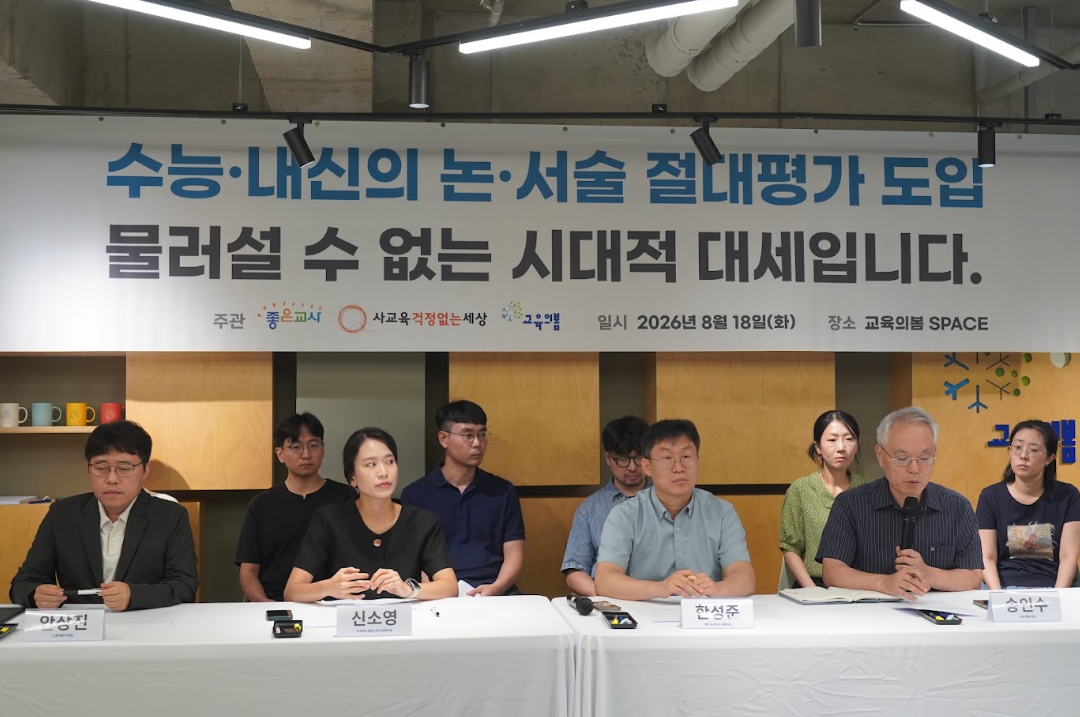
Educational civic organizations have urged for a gradual transition from the current multiple-choice-based College Scholastic Ability Test (CSAT) and internal evaluations to a subjective evaluation method focusing on written and essay formats, in line with the 81st anniversary of Liberation Day.
Education Spring, No Worries about Private Education, and Good Teacher Movement jointly issued a statement on the 18th, stating that "We must move from a country that follows the correct answers to a country that asks questions," and demanded that the direction of transitioning to a subjective evaluation method encompassing CSAT and internal evaluations be specified in the national education development plan scheduled to be finalized in March 2027.
These organizations emphasized that in the AI era, the ability to define problems, ask questions, and verify the basis and logic of the given answers is more important than quickly finding predetermined answers.
They stated, "AI can generate plausible answers endlessly, but determining whether those answers are correct, what the basis is, and whether there are logical gaps remains the responsibility of humans," and added, "The ability to verify answers comes from the experience of creating answers based on one's own thoughts."
In particular, they highlighted that the evaluation method influences school lessons significantly.
They argued, "Evaluation is not the final step of education but the first button that determines what and how to teach," and claimed, "As long as the evaluation method demands choosing the correct answer, lessons will ultimately converge to selecting the correct answer."
They further pointed out, "In the world outside of schools, answers are not provided on a platter," and stated, "The ability to define problems, gather evidence, anticipate counterarguments, and persuade one's own conclusions cannot be cultivated merely by practicing to choose one answer from five options."
It was also mentioned that the multiple-choice evaluation method was not originally designed to measure deep thinking skills.
The organizations criticized that the objective test format evolved in the 1910s in the United States as a method to evaluate a large number of people quickly and reduce the burden of grading, stating, "The cheap, fast, and convenient evaluation method has been used as a crucial yardstick in our society for over half a century to determine students' futures."
They also noted the recent remarks from the President and the National Education Commission criticizing the limitations of the current objective-based CSAT.
Referring to the President's education ministry report speech on the 5th and Chairman Cha Jeong-in of the National Education Commission's speech at the National Assembly's Education Committee on the 12th, the organizations evaluated that "Discussions on the necessity of a shift to an evaluation system suitable for the AI era at the national level are actively taking place."
However, they emphasized the need to establish a system to ensure the fairness and reliability of grading before expanding the introduction of subjective evaluation methods.
Citing overseas examples such as France's Baccalauréat and Germany's Abitur, they stated, "The fairness of subjective evaluations depends not on the evaluation method itself but on the infrastructure the country builds, such as multiple grading, coordination among graders, clear grading criteria, and a system for filing objections."
They diagnosed that the reason for variations in subjective evaluation within schools and among teachers in South Korea was due to the lack of national-level support systems.
The organizations argued, "Until now, the quality of subjective grading has been left to individual teachers' dedication and schools' circumstances," and suggested, "Rather than burdening teachers more, the nation should establish evaluation management centers, grading professionals, multiple grading, and adjustment systems."
Regarding concerns that subjective evaluations may further expand private education, they countered that the high-stakes relative evaluation and university-specific essay exams have been the main reasons for the growth of private education, rather than the evaluation format itself.
They stated, "As long as the relative evaluation structure that does not allow most to get the correct answer is maintained, any evaluation method can lead to extreme discriminatory competition," and added, "The transition to subjective evaluations should be discussed in conjunction with the reform of the relative evaluation system."
Especially concerning the recent increase in private education costs for high school seniors' essay exams, they analyzed, "The significant influence comes from the separate university-specific essay exams conducted by universities, not from the subjective evaluations based on school curricula."
They argued, "If subjective evaluations based on school curricula stabilize in internal evaluations and CSAT, making school lessons themselves ready for college entrance preparation, the need for separate university-specific essay exams may actually decrease."
In line with this, the three organizations demanded the gradual transition to subjective evaluations to be specified in the national education development plan, and urged the establishment of public grading infrastructure such as evaluation management centers and multiple grading systems.
They also proposed that the reform of the relative evaluation system and measures against private education should be prepared together, along with enhancing teachers' evaluation professionalism, redesigning tasks, and reducing the number of students per class.
They emphasized the need for sufficient verification and notice periods through research schools and pilot regions before full implementation.
The organizations pointed out, "A transition without preparation is not reform but chaos," and criticized, "Without deciding on the direction due to difficulties, no preparation such as training graders, teacher training, budget allocation, etc., can begin."
They further stressed, "Declaring the direction clearly while not rushing without preparation is the role of the nation," and emphasized, "On the occasion of the 81st Liberation Day, it is time to return the right to think for themselves to students."
교육시민단체 “오지선다형 넘어 서·논술형 절대평가로 단계적 전환해야”
“AI 시대에는 정답 고르기보다 질문·검증 능력 중요”
채점 공정성 인프라·상대평가 개편·충분한 준비기간 병행 촉구
교육시민단체들이 광복 81주년을 맞아 현행 오지선다형 중심의 수능과 내신 평가를 서·논술형 절대평가 방식으로 단계적으로 전환해야 한다고 촉구했다.
교육의봄과 사교육걱정없는세상, 좋은교사운동은 18일 공동 입장문을 내고 “정답을 좇던 나라에서 질문을 던지는 나라로 나아가야 한다”며 수능과 내신을 아우르는 서·논술형 평가로의 전환 방향을 2027년 3월 확정 예정인 국가교육발전계획에 명시할 것을 요구했다.
이들 단체는 AI 시대에는 이미 정해진 답을 빠르게 찾아내는 능력보다 문제를 정의하고 질문하며, 제시된 답의 근거와 논리를 검증하는 능력이 중요하다고 강조했다.
단체들은 “AI는 그럴듯한 답을 무한히 만들어내지만 그 답이 옳은지, 근거가 무엇인지, 논리에 구멍은 없는지를 판단하는 일은 여전히 사람의 몫”이라며 “답을 검증하는 능력은 자신의 생각을 토대로 답을 만들어 본 경험에서 나온다”고 밝혔다.
특히 평가 방식이 학교 수업을 좌우한다는 점도 강조했다.
이들은 “평가는 교육의 마지막 절차가 아니라 무엇을 어떻게 가르칠지를 결정하는 첫 단추”라며 “평가 방식이 정답 고르기를 요구하는 한 수업 역시 결국 정답 고르기로 수렴할 수밖에 없다”고 주장했다.
이어 “학교를 나와 마주하는 세상에서는 정답이 보기로 주어지지 않는다”며 “문제를 정의하고, 근거를 모으고, 반론을 예상하고, 자신의 결론을 설득하는 능력은 다섯 개 보기 가운데 하나를 고르는 훈련만으로 기르기 어렵다”고 지적했다.
오지선다형 평가가 본래 깊은 사고력을 측정하기 위해 만들어진 방식이 아니라는 점도 들었다.
단체들은 1910년대 미국에서 객관식 시험이 대규모 인원을 신속하게 평가하고 채점 부담을 줄이기 위한 방식으로 발전했다며 “값싸고 빠르고 편리한 평가 방식이 반세기가 넘도록 우리 사회에서 학생의 미래를 결정하는 핵심적인 잣대로 사용돼 왔다”고 비판했다.
최근 대통령과 국가교육위원회에서도 현행 객관식 중심 수능의 한계를 지적하는 발언이 잇따른 점도 언급했다.
단체들은 지난 5일 대통령의 교육부 업무보고 발언과 12일 차정인 국가교육위원장의 국회 교육위원회 발언을 거론하며 “국가 차원에서도 AI 시대에 맞는 평가체제로의 변화 필요성이 본격적으로 논의되고 있다”고 평가했다.
다만 서·논술형 평가 도입을 곧바로 확대하기보다 채점의 공정성과 신뢰성을 확보할 제도적 기반부터 구축해야 한다고 강조했다.
이들은 프랑스 바칼로레아와 독일 아비투어 등 해외 사례를 들며 “서·논술형 평가의 공정성은 평가 방식 자체가 아니라 복수 채점, 채점자 간 조정, 명확한 채점 기준, 이의신청 제도 등 국가가 어떤 인프라를 구축하느냐에 달려 있다”고 밝혔다.
국내 학교에서도 이미 서·논술형 평가가 시행되고 있지만 학교와 교사별 편차가 발생하는 이유 역시 국가 차원의 지원 체계가 부족했기 때문이라고 진단했다.
단체들은 “지금까지 서·논술형 채점의 질을 사실상 개별 교사의 헌신과 학교의 형편에 맡겨 왔다”며 “교사에게 더 많은 부담을 떠넘길 것이 아니라 국가가 평가관리센터와 채점 전문인력, 복수채점과 조정체계를 구축해야 한다”고 주장했다.
서·논술형 평가가 사교육을 더욱 확대할 것이라는 우려에 대해서는 평가 형식 자체보다 고부담 상대평가와 대학별 논술고사가 사교육을 키워 온 주요 원인이라고 반박했다.
이들은 “다수가 정답을 맞히면 안 되는 상대평가 구조가 유지되는 한 어떤 평가 방식도 극단적인 변별 경쟁으로 흘러갈 수 있다”며 “서·논술형 전환은 상대평가 체제 개편과 함께 논의돼야 한다”고 밝혔다.
특히 최근 고3 논술 사교육비 증가 현상에 대해서도 “학교 교과에 기반한 서·논술형 평가 때문이 아니라 대학들이 별도로 실시하는 대학별 논술고사가 형성한 시장의 영향이 크다”고 분석했다.
그러면서 “학교 교육과정에 기반한 서·논술형 평가가 내신과 수능에 안정적으로 정착해 학교 수업 자체가 대입 준비가 된다면 별도의 대학별 논술고사의 필요성은 오히려 줄어들 수 있다”고 주장했다.
세 단체는 이에 따라 국가교육발전계획에 서·논술형 평가로의 단계적 전환을 명시하고, 평가관리센터 설립과 복수채점 체계 등 공적 채점 인프라를 구축할 것을 요구했다.
또 상대평가 체제 개편과 사교육 대책을 함께 마련하고, 교사의 평가 전문성 연수와 업무 재설계, 학급당 학생 수 감축 등을 병행해야 한다고 제안했다.
전면 시행에 앞서 연구학교와 시범지역을 통한 충분한 검증과 예고기간도 필요하다고 밝혔다.
단체들은 “준비 없는 전환은 개혁이 아니라 혼란”이라면서도 “어렵다는 이유로 방향 자체를 결정하지 않으면 채점 인력 양성과 교사 연수, 예산 투입 등 어떤 준비도 시작할 수 없다”고 지적했다.
이어 “가야 할 방향은 분명히 선언하되 준비 없이 서두르지 않는 것이 국가의 역할”이라며 “광복 81주년을 맞아 이제는 학생들에게 스스로 생각할 권리를 돌려줘야 한다”고 강조했다.