
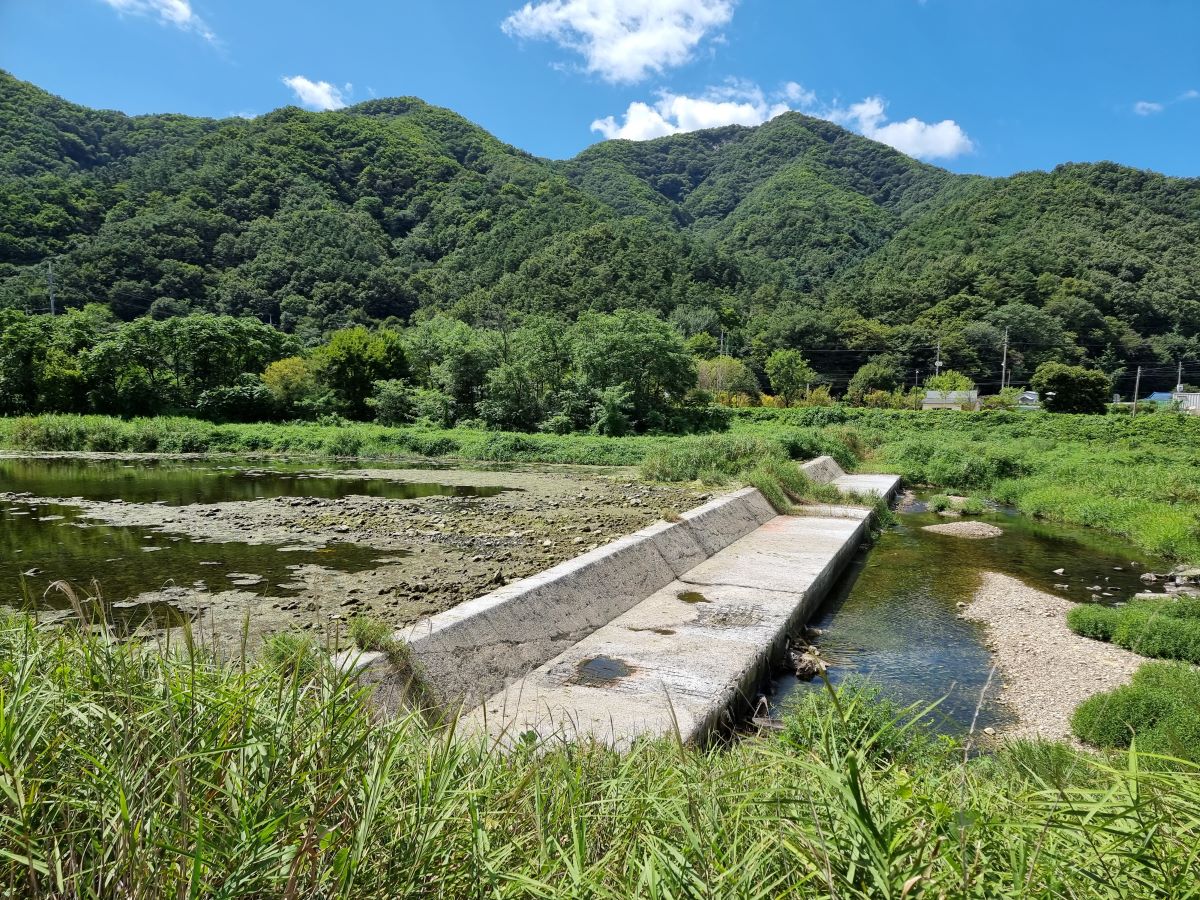
The quantified effects of the removal of the abandoned weirs in the upper reaches of Jeonju Stream have been proven for the first time in Korea, including lowering flood levels, improving water quality, and reducing greenhouse gases as part of a comprehensive response to climate change.
The Forests for Sharing Foundation and the HanGyeong National University research lab announced that if all 12 weirs in Jeonju Stream are removed, approximately 170 million cubic meters of water will be restored to its natural state annually, using the international standard methodology (VWBA). In particular, it was confirmed that during heavy rainfall events, the flood level could decrease by up to 1.18 meters without the need for artificial embankment construction, significantly enhancing flood safety.
Furthermore, the activation of water self-purification processes led to a maximum increase of 1.87 mg/L in dissolved oxygen (DO), showing the highest water quality improvement among the surveyed rivers. Additionally, a reduction of over 110,000 kgCO₂eq of greenhouse gases annually is expected due to the decrease in methane emissions from stagnant water.
Professor Baek Gyeong-oh, who participated in the research at HanGyeong National University, emphasized that "excessive embankments disrupt ecosystems and have minimal effects on flood mitigation," highlighting that the true flood control measure lies in the removal of abandoned structures.
The Jeonbuk Environmental Movement Union, along with the '2026 Citizen Science Investigation Team' of 30 members, is actively engaged in monitoring the ecology of Jeonju Stream. They are urging Jeonju City, Wanju County, and the Jeonbuk Regional Environmental Office to halt indiscriminate embankment and deforestation activities and to transition to a natural-based solution (NbS) to completely change the river management paradigm.
전주천 상류 ‘상죽음보’ 철거 시 홍수위 최대 1.18m 떨어진다
숲과나눔·전북환경운동연합 “용도 상실한 보 철거해 자연기반해법(NbS)으로 전환해야”
전주천 상류의 상죽음보 등 기능이 상실된 보를 철거할 경우 홍수위 저하와 수질 개선, 온실가스 감축 등 다각적인 기후위기 대응 효과가 국내 최초로 정량 입증됐다.
(재)숲과나눔과 한경국립대학교 연구실은 국제 표준 방법론(VWBA)을 적용한 연구를 통해 전주천 내 12개 보를 모두 철거할 경우 연간 약 1억 7천만 ㎥의 물이 자연 상태로 환원된다고 밝혔다. 특히 상죽음보 철거 시 집중호우 시 홍수위가 최대 1.18m 낮아져 인위적인 제방 공사 없이도 치수 안전성이 대폭 향상되는 것으로 확인됐다.
또한 물의 자정작용 활성화로 용존산소(DO)가 최대 1.87mg/L 증가해 조사 대상 하천 중 가장 높은 수질 개선 효과를 보였으며, 정체수에서 발생하는 메탄이 감소해 연간 11만 kgCO₂eq 이상의 온실가스 감축 효과도 기대된다.
연구에 참여한 백경오 한경국립대 교수는 “과도한 준설은 생태계를 교란시킬 뿐 홍수 저감 효과가 미미하다”며 “진정한 치수 대책은 용도 상실 구조물을 철거하는 것”이라고 강조했다.
전북환경운동연합은 ‘2026 시민과학조사단’ 30명과 함께 전주천 생태 모니터링에 나서는 한편, 전주시와 완주군, 전북지방환경청을 향해 무분별한 준설·벌목 행정을 중단하고 자연기반해법(NbS)으로 하천 관리 패러다임을 전면 전환할 것을 촉구했다.