
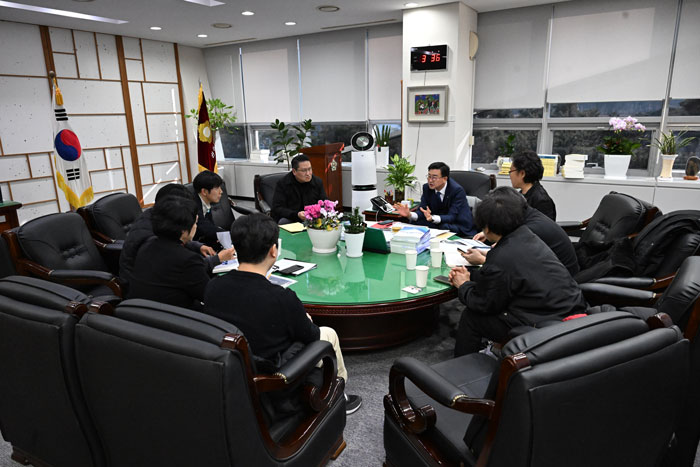
The chairman of the Wanjoo County Council held the first meeting to proactively respond to the changes in the Jeonbuk metropolitan transportation system following the amendment of the Special Act on Metropolitan Transportation Management in the metropolitan area (Daegwang Law).
The amendment bill of the Daegwang Law was passed in the National Assembly on April 2, 2025, and was promulgated on the 22nd of the same month. According to the amendment, Jeonbuk Special Self-Governing Province, including Jeonju, was included in the application scope of the metropolitan transportation system in the metropolitan area, and a legal basis for national financial support for metropolitan transportation facilities such as metropolitan roads, railways, and transfer centers was established for Jeonju City, Wanjoo County, Iksan City, Gimje City, Gunsan City, and others.
According to the Wanjoo County Council, Chairman Yu held a meeting with relevant departments on the 12th in the council chamber to discuss the establishment of a Wanjoo-centered metropolitan transportation network and the strategy for constructing a composite metropolitan transfer center. This was the first official discussion at the Wanjoo County level after the amendment of the law, expressing the intention for Wanjoo to be a 'leading designer' in the restructuring process of the metropolitan transportation system.
The county plans to actively design the transportation order in the northwestern part of Jeonbuk by comprehensively reviewing the route system connecting the innovation city, industrial complexes, major residential areas, and the capital region, as well as the placement of transfer hubs. Participants empathized with the need for a composite transfer center through the integration of metropolitan buses, BRT, and railways, suggesting that Wanjoo could grow as a transportation hub connecting Jeonju, Iksan, and Gunsan.
Chairman Yu stated, "The amendment of the Daegwang Law is a turning point for redesigning the Jeonbuk metropolitan transportation system," and expressed, "We will establish a metropolitan transfer hub centered around Wanjoo to lead a balanced metropolitan transportation network." He further emphasized, "Metropolitan transportation is an area of cooperation for enhancing residents' mobility rights and regional competitiveness, rather than administrative integration."
The Wanjoo County Council plans to gradually concretize the establishment of a Wanjoo-led metropolitan transportation network by continuing discussions with relevant departments and companies.
완주군의회, 대광법 개정 대응 간담회…“광역환승 허브 구축 첫걸음”
유의식 완주군의회 의장이 대도시권 광역교통 관리에 관한 특별법(대광법) 개정에 따른 전북권 광역교통체계 변화에 선제 대응하기 위한 첫 간담회를 열고 광역교통 거점 구축에 나섰다.
대광법 일부개정법률안은 2025년 4월 2일 국회 본회의를 통과해 같은 달 22일 공포됐다. 개정에 따라 전북특별자치도에서는 전주권이 대도시권 광역교통체계 적용 대상에 포함됐으며, 전주시와 완주군·익산시·김제시·군산시 등이 법 적용 범위에 들어가 광역도로·철도·환승센터 등 광역교통시설에 대한 국가 재정 지원의 제도적 기반이 마련됐다.
완주군의회에 따르면 유 의장은 12일 의장실에서 관계 부서와 간담회를 열고 완주 중심 광역교통망 구성과 복합형 광역환승센터 구축 전략을 논의했다. 법 개정 이후 완주군 차원의 첫 공식 논의 자리로, 광역교통체계 재편 과정에서 완주가 ‘주도적 설계자’로 나서겠다는 의지를 밝혔다.
군은 혁신도시와 산업단지, 주요 주거지, 수도권을 연결하는 노선 체계와 환승 거점 배치를 종합 검토해 전북 서북권 교통 질서를 능동적으로 설계한다는 계획이다. 참석자들은 광역버스·BRT·철도 연계를 통한 복합형 환승센터 필요성에 공감하며, 완주가 전주·익산·군산을 잇는 교통 허브로 성장할 수 있다는 의견을 제시했다.
유 의장은 “대광법 개정은 전북권 광역교통체계를 새롭게 설계할 전환점”이라며 “완주가 중심이 되는 광역환승 허브를 구축해 균형 있는 광역교통망을 주도하겠다”고 밝혔다. 이어 “광역교통은 행정통합이 아닌 주민 이동권과 지역 경쟁력 강화를 위한 협력의 영역”이라고 강조했다.
완주군의회는 관련 부서·기업과 협의를 이어가며 완주 주도의 광역교통망 구축 방안을 단계적으로 구체화할 방침이다.